Essay: Illustrated Editions of the Grimms’ Fairy Tales in Special Collections by Ronald Patkus
One of the Highlights of the Archives & Special Collections Library at Vassar is its collection of children’s books. The collection is actually best described as a gathering of several collections formed by alumnae/i, friends, others connected to the college, and the librarians. Without doubt the bulk of the material is made up of works published in England and the United States since 1800. Within this area there are some areas of special focus, such as titles relating to Mother Goose. The collection is a useful resource for teaching, and it has also provided opportunities for several exhibitions, including in more recent years The Age of Alice: Fairy Tales, Fantasy, and Nonsense in Victorian England (which took place on the 150th anniversary of Lewis Carroll’s Alice), and The Children’s Books of Nancy Willard. Apart from the material relating to the literature of England and the United States, there are also present titles dealing with other places and times. One thinks for instance of Charles Per-rault’s Histoires ou Contes du Temps Passé, or Tales and Stories from the Past; Hans Christian Andersen’s Eventyr, fortalte for børn, or Fairy Tales for Children; and Carlo Collodi’s Le avventure di Pi-nocchio: Storia di un burattino, or Pinocchio, the Story of a Puppet. In addition, some of the most significant works from another culture are editions of the fairy tales of the Brothers Grimm. In fact, a search of the Library’s online catalogue retrieves about 100 titles in the rare book collection (and of course many more titles are available in the Main Library). As one might expect, most of these are in either German, or English. They cover a long stretch of time, from the early years of the nineteenth century right up to the present. They therefore reflect the trends of bookmaking that took place over this period. The vast majority are illustrated in some way, and what follows is a quick overview of these editions. Details about some of the books mentioned can be found in the exhibition captions that appear later in this brochure.
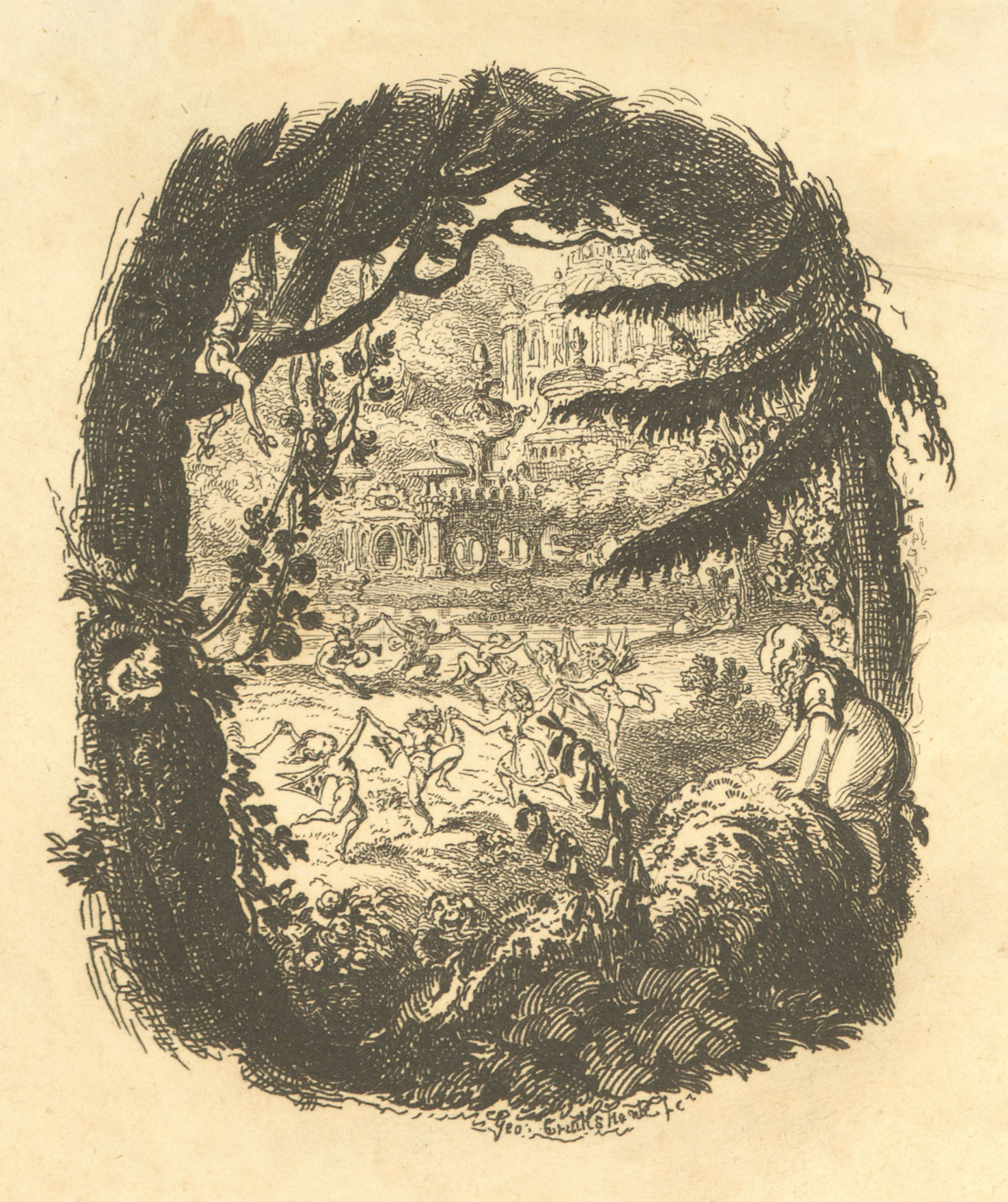
Most of the early nineteenth century editions are small, with black-and-white illustrations. Vassar is fortunate to have recently acquired a copy of the second edition of the Grimms’ tales, which actually was the first illustrated edition, with etchings by Ludwig Emil Grimm, brother of Jacob and Wilhelm. His frontispiece to volume one, depicting “Little Brother and Little Sister,” is iconic, and filled with sensitivity. The earliest English edition dates from 1823, and features the work of George Cruikshank, again in the form of etchings, though in a different style (see Fig. 1). Other German editions from the middle and later decades of the century are in the collection; in their cheaper materials, several reflect the influence of the Industrial Age on printing. A number feature wood engravings, which became a common artform for books and periodicals, though there are also colored illustrations present in some books (see Fig. 2).
By the last years of the nineteenth century and the early years of the twentieth, some artists were reacting against industrial practices and styles, and among Vassar’s holdings are examples of the new Arts and Crafts movement, and Art Nouveau. Of special note here are works by the English artist Walter Crane, who was a key figure of the former movement, and perhaps the best-known illustrator of children’s books of his time. There are several editions of books with his illustrations of Grimm’s fairy tales in the collection; together they tell us something about Crane’s ongoing popularity (see Fig. 3). Art Nouveau in Germany and Austria was known as “Jugendstil,” and one set of volumes published and republished in Vienna by Martin Gerlach as part of a long series of children’s books features decorative elements of this style on its covers and endpapers, as well as colorful illustrations by several artists.
Artists drawing inspiration from these and other artistic move-ments helped bring about what has been called the “Golden Age of Book Illustration.” Reaching its height in the first decades of the twentieth century, it featured major artists who re-interpreted well-known works of literature, often using lithography and other new technologies. One thinks especially of the English artist Arthur Rackham and the Danish artist Kay Nielsen; their books are highpoints of Vassar’s collection and the “Golden Age” as a whole. The college owns five editions of the Grimms’ tales illustrated by Rackham, some printed in London, some in New York, all bearing his unique style, often showing a sombre aspect. His Little Brother & Little Sister and Other Tales by the Brothers Grimm is a large limited edition of only 525 copies, signed by the artist. Some of the illustrations are pen and ink, and others are in color, on plates (see Fig. 4). Kay Nielsen’s Hansel and Gretel and Other Stories by the Brothers Grimm was produced in a similar fashion; it too is a limited edition, signed by Nielsen, and with many mounted color plates bearing the artist’s energy and intensity. The Library acquired this work recently in order to bring attention to Nielsen’s work (see Fig. 5).
Vassar’s collection of the Grimms’ tales is strongest in twentieth-century editions, and many of them date from the years following the end of World War II. Most, though not all, are in English. Sometimes books present a collection of tales, but throughout this period one finds a great number of editions that focus on only one tale, or a small number of them. Thus we see books dealing, for instance, with “The Bremen Town Musicians,” “The Fisherman and his Wife,” “The Wolf and the Seven Kids,” “Cinderella,” “Hansel and Gretel,” and of course “Snow White;” the list goes on and on. It almost goes without saying that, as with earlier examples, the contribution of artists to all of these books can be integral. Some have a whimsical feeling about them; one thinks especially of titles illustrated by Fritz Kredel, Hans Fischer, and L. Leslie Brooke (see Fig, 6). A number of artists working in the 1960s and 70s, like Maurice Sendak, Trina Schart Hyman, Nancy Ekholm Burkert, and David Hockney, have very different interpretations (see Fig. 7).
Interest in the Grimms’ fairy tales has not waned in the twenty-first century, and there are examples at Vassar that bear this out. The Main Library and the Art Library include trade books illustrated by people like Johanna Westerman, Matt Tavares, John B. Gruelle, Andrea Dezsö, and Natalie Frank. In Special Collections, the focus is on fine press books and art-ist’s books. Among the former is a collection of three tales with wood engravings by Rebecca Gilbert, printed and published by the Thornwillow Press of Newburgh, New York. We also have a collection of ten tales with very abstract, modern illustrations made by Edition Schwarze Seite in Germany. For artist’s books, Vassar is fortunate to have two works by the German artist Barbara Beisinghoff: Die Wilden Schwäne, which came out in 2001 (see Fig. 8), and The Enchanted Forest, from 2016. Interestingly, this last work was actually produced as a special art project with 60 students from the Poughkeepsie Day School.
A brief examination of the key groupings of works in the collection relating to the Grimms shows us that even if books are produced around the same time and bear certain traits of the time period, they can still be very different from one another. This becomes especially true if we consider not only illustration, but also other aspects of book production. For instance, bibliographic features such as the texts and paratexts, format, binding, paper, layout and design, typography can also be significant. In fact, it’s interesting to see how these other features interact, or don’t, with the illustrations. This interaction ultimately produces the unique experience that a reader will have when picking up a book, even when one aspect, such as the illustration, stands out.
Following on this idea, one should mention that, in fact, Vassar’s collection gives some clues about readers’ interests and experiences with Grimms’ fairy tales. The history and provenance of Vassar’s copies can be illuminating, for it tells us something about
the reception of these books in the culture and in our community. Several were given by the infamous Fanny Borden, a graduate of the class of 1898 and for many years the head librarian at Vassar. Others were given in her memory, such as Rackham’s Little Brother & Little Sister and Other Tales, donated by one of our most significant donors, Rebecca Lowrie ’13. Several other titles were given by Louise Seaman Bechtel ’15, a giant in the world of children’s literature who for many years was editor of the juvenile book department at the American publisher Macmillan. More recently, the Cerimon Fund, which was set up by Bechtel, has supported the acquisition of several editions of the Grimm fairy tales; a highlight is Maurice Sendak’s copy of the second German edition. The children’s book collection of Katherine Gesell Walden ’35 also includes a number of works featuring stories from the Grimms.
Overall, the Vassar collection of illustrated editions of the Grimms’ fairy tales is substantial and wide-ranging, with unique aspects. It forms a great resource for faculty and students eager to learn about the history of the text, and its many appearances in book form. It’s no wonder therefore that it can be useful in the classroom and in exhibitions such as the one currently on view. The exhibition is made up of some of the most important books from the collection, but it should be stressed that due to space limitations, many books could not be included. One thinks, for instance, of some illustrated German works from the 1860s, American and English trade editions from the early 20th century, and contemporary fine press books from Germany and the United States. We hope this exhibition and its brochure offers some insights, and may lead to other explorations in the future!
Mr. Patkus is Head of Special Collections, College Historian, and Adjunct Associate Professor of History on the Frederick Weyerhaeuser Chair.
This page has paths:
- Visions of Wonder vclibrary