During the nineteen-teens student and alumnae activists worked on both state and national initiatives to secure women’s voting rights. These activists organized and marched in major suffrage parades in New York and Washington, D.C. The movement had already divided between moderates and militants. In 1917, after the U.S. entered World War I, the rift widened further over how to respond to the conflict. On one side were activists who argued that suffragists should give patriotic support to the war effort. On the other side were those who advocated criticizing President Woodrow Wilson for his refusal to support a national suffrage amendment. The latter carried on with public protests despite attacks on their patriotism, some even sacrificing themselves physically for the cause.
Banner used by Elsie Hill (Class of 1906) during Connecticut suffrage events in 1913.
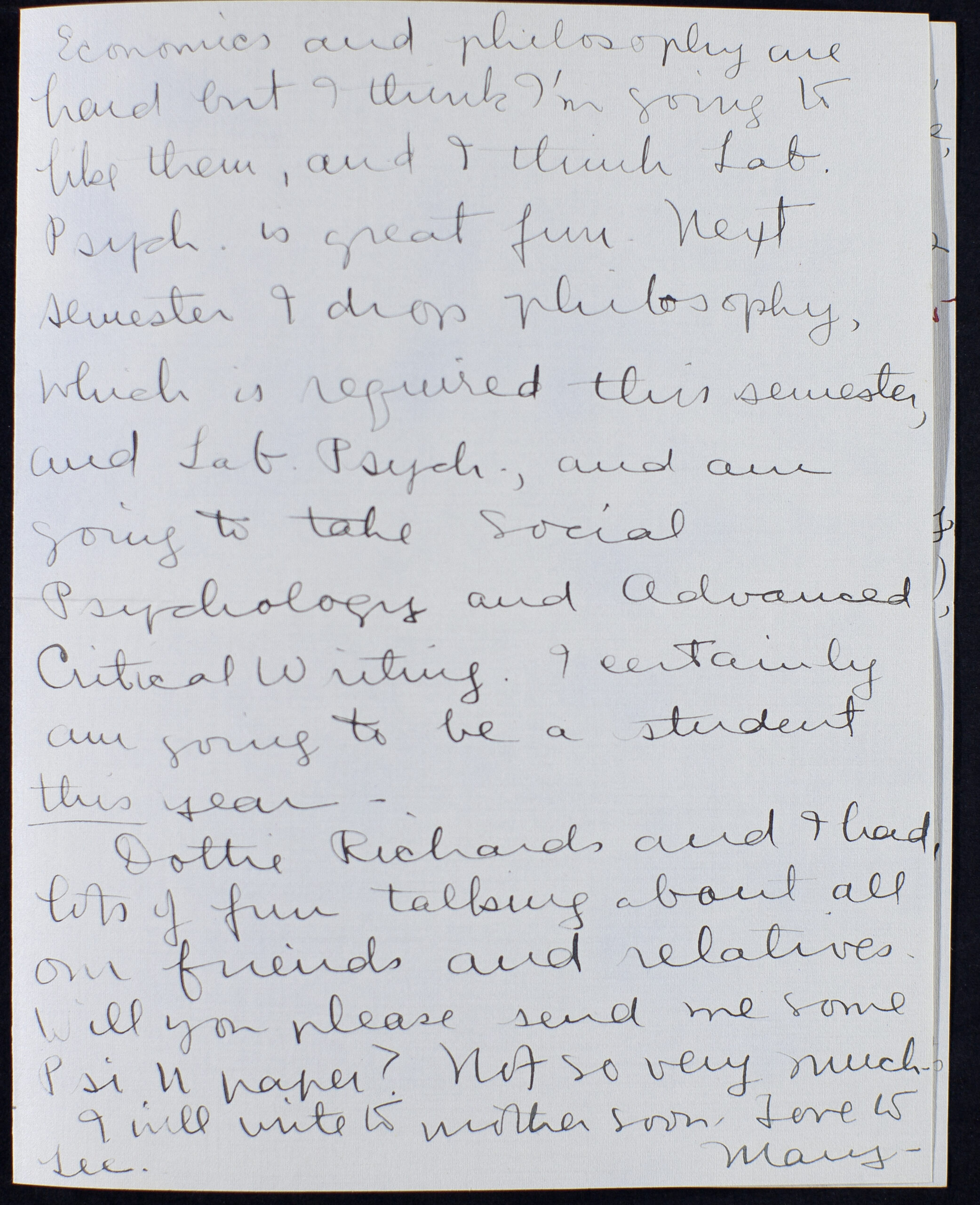
Mary Culver Pollack (Class of 1917) letter (22 September 1915) and envelope w. “Votes for Women” sticker
The suffrage movement developed a huge marketing machine to push its message to the American public, producing huge numbers of buttons, cards, and other suffrage-branded ephemera. Vassar students did their part by using such items, including envelope stickers like the one below.
Photograph Inez Milholland (Class of 1909) on horse (1913)
The charismatic Milholland energized activists and thrilled crowds with her appearances at suffrage parades on horseback. This photo was taken during a parade in New York City.
“Julia Lathrop to Speak at Mass Meeting.” Pokeepsie Evening Enterprise (9 October 1915)
While at Vassar to participate in the celebration of the College’s 50th Anniversary, prominent social reformers Julia Lathrop (Class of 1880) and Katherine Davis (Class of 1892) spoke at a mass rally in Poughkeepsie in support of the 1915 New York State suffrage referendum.
Elizabeth McShane Hilles was among a group of activists arrested in Washington D.C. during protests in front of the White House in 1917.
Elizabeth McShane Hilles (Class of 1913), Jail Notes (November 1917)
While in jail, McShane and some of her fellow suffragists undertook a hunger strike. She kept detailed notes about the forced feeding she and others suffered at the hands of their guards.