Essay: Illustrating the Harlem Renaissance: Aaron Douglas, Ancient Egypt, and Modern Life by Caroline Culp
When he arrived in Harlem in 1925, Aaron Douglas (1899-1979), the most important artist of the Harlem Renaissance, slept on a friend’s couch while taking painting lessons from the German American portraitist Winold Reiss.1 Douglas had left his position as a high school art teacher in Kansas City, encouraged by Charles Johnson, the publisher of Opportunity magazine, to move to New York City and join what was then a revolution in Black life. His first assignments were to create illustrations—covers for Johnson’s Opportunity magazine and for The Crisis, W.E.B. Du Bois’s periodical for the National Association for the Advancement of Colored People (NAACP). Though he is best known today as a muralist who painted monumental canvases, Aaron Douglas began his career at a much smaller scale: as a book illustrator.
Douglas was one of many thousands of Blacks who came to New York City during the Great Migration. Throughout this period of resettling, the city’s Black population grew 257 percent: from 91,709 in 1910 to 327,706 in 1930. As well, by 1930 some 98,620 foreign-born Blacks had also migrated to the United States, with nearly half that number finding homes in Harlem.2 With this booming population came a blossoming in Black culture. Known during the 1920s and ’30s as the “New Negro Movement,” the period was marked by important advances in music, dance, art, fashion, literature, theater, politics, and scholarship. Harlem was the world’s capitol for Black cultural life. And Aaron Douglas was at the heart of it.
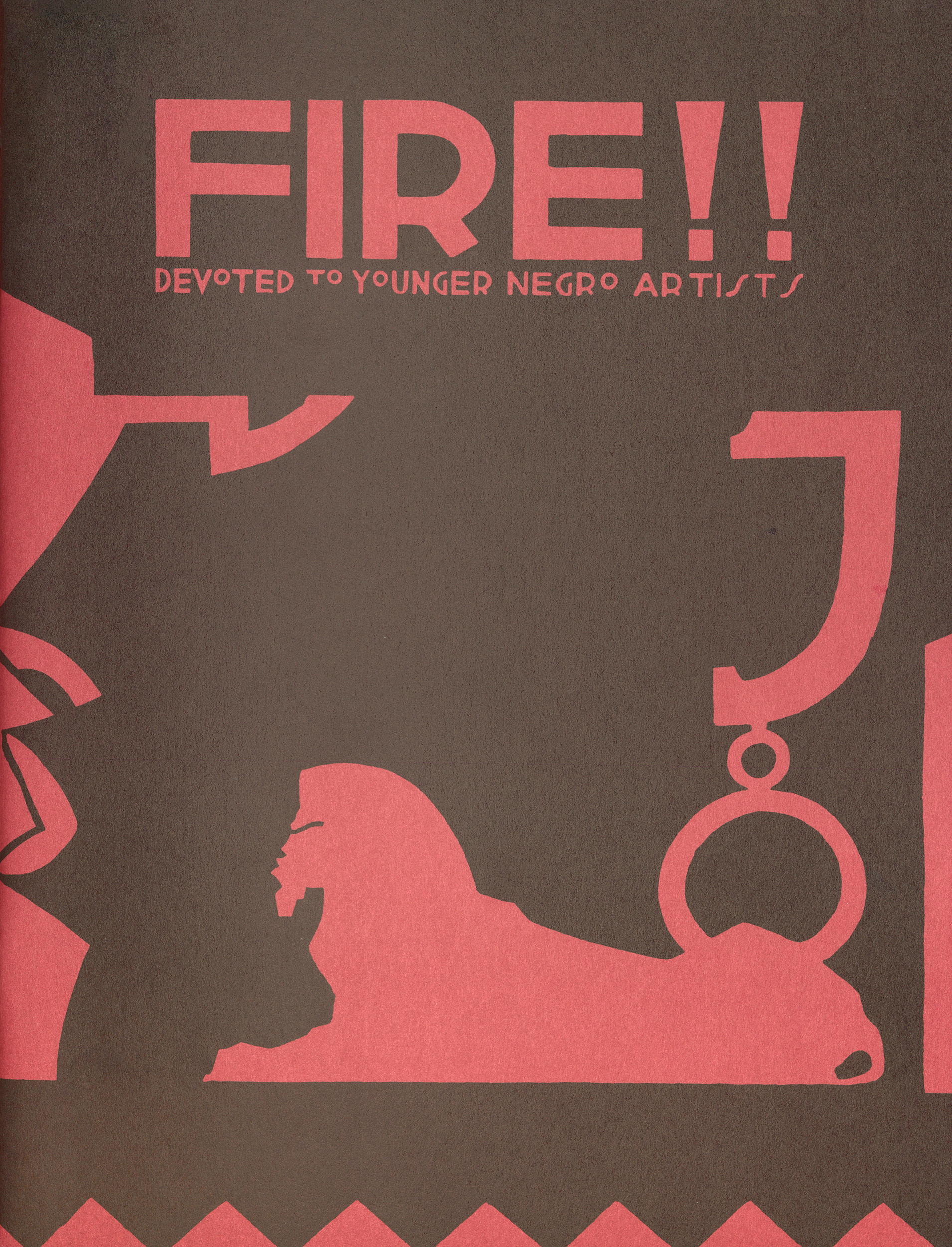
By 1926, the artist had settled himself in a boarding house on 136th Street—a residence he shared with the writer Wallace Thurman. Along with Langston Hughes and Zora Neale Hurston, frequent visitors to 136th Street, Thurman edited a single-issue literary magazine entitled Fire!! Fire!! A Quarterly Devoted to Younger Negro Artists, and commissioned original cover art from Douglas for it (Fig. 3). Working in only two colors—black ink printed on red paper—Douglas’s design interlocks two silhouetted forms: a face in profile, a hooped earring in its ear, and a stern-faced Egyptian sphinx. While the sphinx is easily spotted, the head, which also faces to the left, is stretched to the very edges of the magazine’s cover, its nostrils, lips, and forehead pressed up against the borders of the image. Along the bottom register, a marching pattern of pyramids lends further visual interest to the design.
In its iconography, Douglas’s illustrated cover drew from Egyptian and biblical traditions. Psalm 68:31 (“Princes shall come out of Egypt; Ethiopia shall soon stretch out her hands to God”) was, for instance, a primary source of Ethiopianist discourse on African American religion during the period. At the same time, the artist’s use of line, form, shape, and flatness demonstrated his commitment to the streamlined patterns of Art Deco and the abstraction of transatlantic modernism. It is in this way that the cover for Fire!! demonstrates Douglas’s development of a new artistic style, one that used ancient African elements to portray modern American Blackness. Within the contemporary bodies of American Blacks, Douglas seems to be saying with this face-in-profile, lies the fearsome power of the ancient Egyptian state.3
Douglas’s new visual language amplified the voices of the Black writers he worked with, creating a bold aesthetic that felt distinctly expressive of the changing culture in Harlem. As Alain Locke, that consummate leader of the New Negro Movement, described in 1925:
Negro life is not only establishing new contacts and founding new centers, it is finding a new soul. There is a fresh spiritual and cultural focusing. We have, as the heralding sign, an unusual outburst of creative expression. There is renewed race-spirit that consciously and proudly sets itself apart.4
The same year, Aaron Douglas had written to Langston Hughes his own rallying call to arms for the movement:
Our problem is to conceive, develop, establish an art era. Not white art painted black…Let’s bare our arms and plunge them deep deep through laughter, through pain, through sorrow, through hope, through disappointment, into the very depths of the souls of our people and drag forth material crude, rough, neglected. Then let’s sing it, dance it, write it, paint it. Let’s do the impossible. Let’s create something transcendentally material, mystically objective…Spiritually earthy. Dynamic.5
Douglas’s mystic, spiritual, and dynamic graphic language would go on to become synonymous with the print culture of the Harlem Renaissance. The boldness of his style and the warmth of his palette established a Black-informed modernist aesthetic that would be adopted and reshaped by a whole generation of artists.
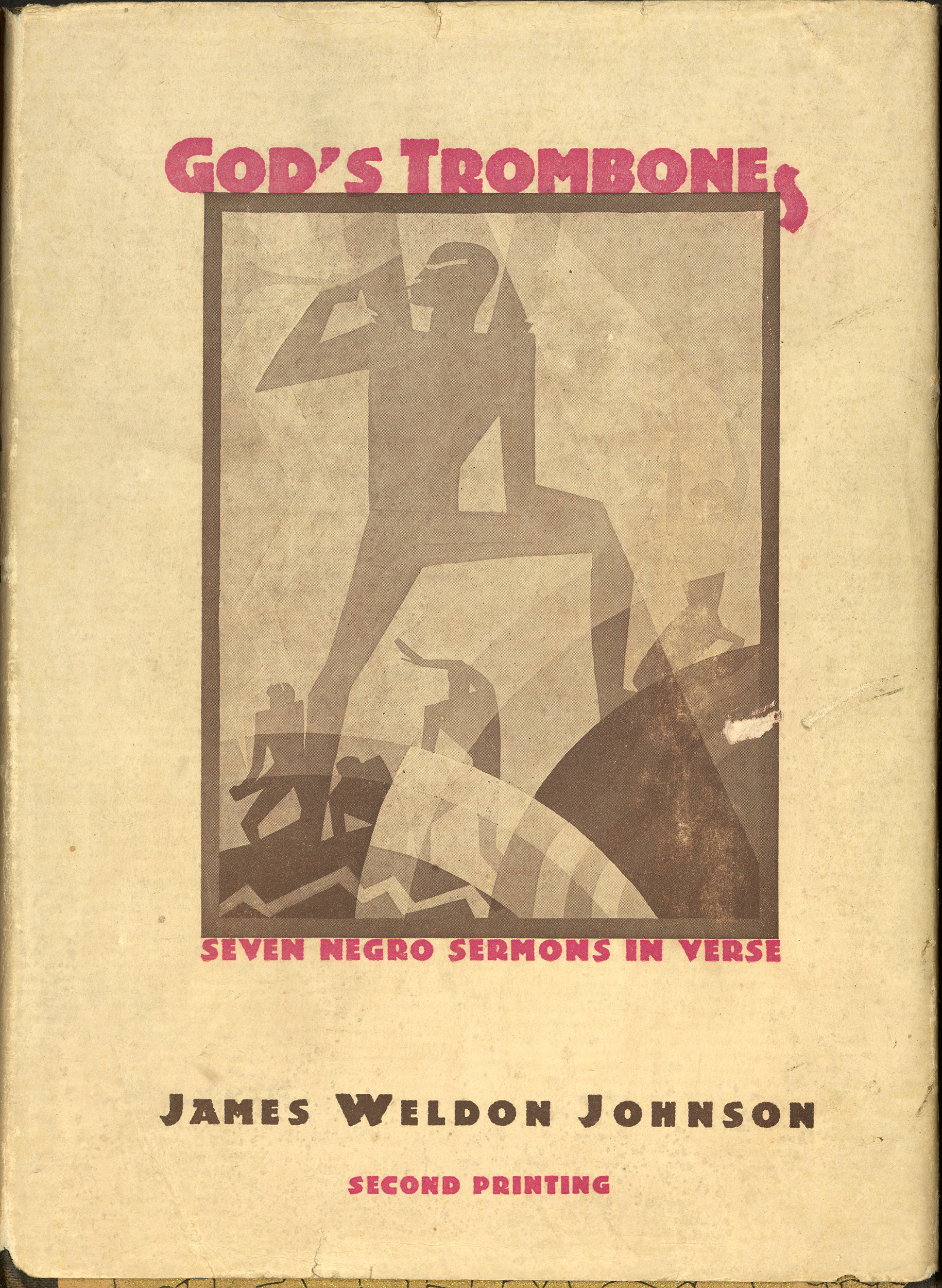
By 1927, Douglas was the choice illustrator for the leading lights of Harlem’s literary world. In that year alone, he was commissioned to illustrate Countee Cullen’s Caroling Dusk, Langston Hughes’s Fine Clothes to the Jew, Gregory Montgomery’s Plays of Negro Life, Charles S. Johnson’s Ebony and Topaz, and James Weldon Johnson’s God’s Trombones: Seven Negro Sermons in Verse. This final volume, God’s Trombones, was a collection of seven sermons inspired by Johnson’s childhood memories of sermons by Black preachers. Each text was illustrated with an accompanying plate by Douglas. On the cover (Fig. 4) is the artist’s The Judgment Day, which illustrates the book’s final poem of the same name.
The image depicts the Archangel Gabriel standing with one foot on a mountain and one in the sea, his trumpet blast sounding the end of the world, his wings extending up beyond the top of the frame towards heaven. Douglas’s illustration was made to not only to pictorialize, but also to enhance the text it accompanied. An excerpt reads:
Oh-o-oh, sinner,
Where will you stand,
In that great day when God’s a-going to rain down fire?
Oh, you gambling man — where will you stand?
You whore-mongering man — where will you stand?
Liars and backsliders — where will you stand,
In that great day when God’s a-going to rain down fire?
Douglas looked to Johnson’s repeated chorus “where will you stand?” to guide the roiling form of his composition. Its focus on the staggered precipice upon which Gabriel stands—this parting of worlds between heaven and hell—lends new dimension to the text it illustrates. Rather than merely mimicking specific lines from a text, as many older modes of illustration did, Douglas instead creates a dynamic interplay between word and image, forging the two into a single unit of enhanced import. By coming together, the artist and writer thus created an active and powerful dialogue. Together, they developed a new iconography of Black modernity.
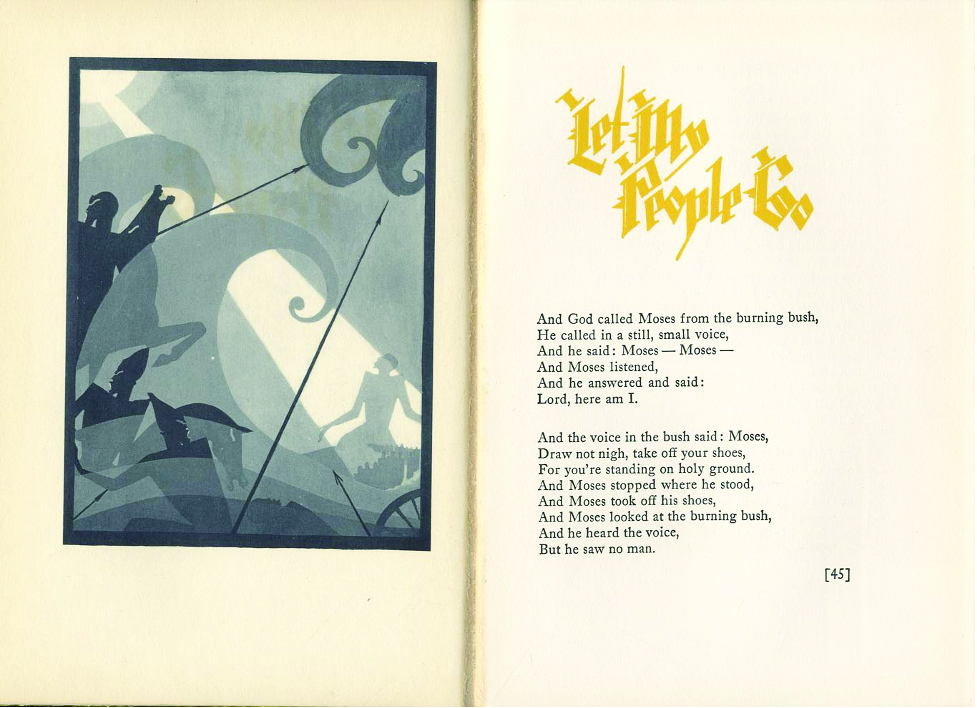
Another illustration Douglas completed for Johnson’s God’s Trombones, entitled Let My People Go (Fig. 5), interprets the Old Testament story about God’s order to Moses to lead the Israelites out of enslavement in Egypt. Similar to his depiction of the Egyptian sphinx in his cover illustration for Fire!!, in Let My People Go Douglas draws again upon the imagery of ancient Egypt. The two figures in the lower left corner of the composition wear Hedjets—the tall white crown of the pharaohs of Upper Egypt. These antagonists are separated from Moses by a curving wave of the Red Sea, which has been parted to admit the clustered figures of fleeing believers seen in the distant background. From the composition’s upper left corner, a strong diagonal of God’s white light beams down in a bright line, enveloping Moses as he kneels in deferential submission.
The story of Moses is a narrative important to enslaved peoples the world over, including American abolitionists, ministers, and politicians during the nineteenth century. The title of Johnson’s poem, “Let My People Go,” even evokes a lyric from the traditional song “Go Down Moses.” It was sung by Blacks enslaved in the American South to express religious feeling, emotional solidarity, or to indicate a coded form of resistance.6 Layering African iconography together with American history in his modern aesthetic of the New Negro, Aaron Douglas’s illustrations for James Weldon Johnson’s sermons in verse helped to produce a dynamic and original artform that reflected Harlem’s new soul.
While he would revisit, decades later, the images from God’s Trombones via a collection of brightly colorful paintings, in his printed book illustrations Douglas’s sparing use of color was a pragmatic and necessary choice. During the 1920s and ’30s, the four-color printing process—a technology developed to mechanically produce images in color—was still prohibitively expensive. Douglas’s use of a grisaille (or grey-scale) palette for his compositions, accompanied by firm modeling, hard lines, and saturated values meant his work would reproduce well when printed in ink of a single color. Enhancing texts that portrayed the new mode of Black identity and fresh interpretations of its history, his grisaille illustrations thus employed dynamic line and graphic shading rather than dramatic coloration to communicate their message.
While Douglas’s designs were incredibly popular among his fellow Harlem Renaissance artists, they did sometimes take time to gain acceptance. In one example, letters from the author Claude McKay survive to suggest he wasn’t so keen on Douglas’s plan for the dust jacket of his 1928 Home to Harlem (Fig. 6). Printed in blue ink on magenta paper, the cover centers the standing body of a Black man silhouetted between a retreating line of skyscrapers and the turrets of a cathedral. His arms are raised in an ambiguous gesture as, behind him, the sun sets below the horizon and the moon rises into the night sky. Musical notations for jazz improvisations float above the curved keys of a piano. All are meant to be icons of life in Harlem.
When the author Claude McKay first saw Douglas’s proposed cover, he had serious reservations. He wrote to his literary agent William Bradley:
I like the cover of the book & the color of the jacket but I don’t like the drawing. It looks so much like the stiff skeleton of a black ape. Has no life and one looking at it will naturally link it with Jake [the novel’s protagonist]. Covarrubias could have done something striking & sympathetic, but I suppose I should not grumble & criticize but be loyal and patriotic as the artist is a colored man.7
A week later and after some thought, McKay wrote again to his agent with a new perspective:
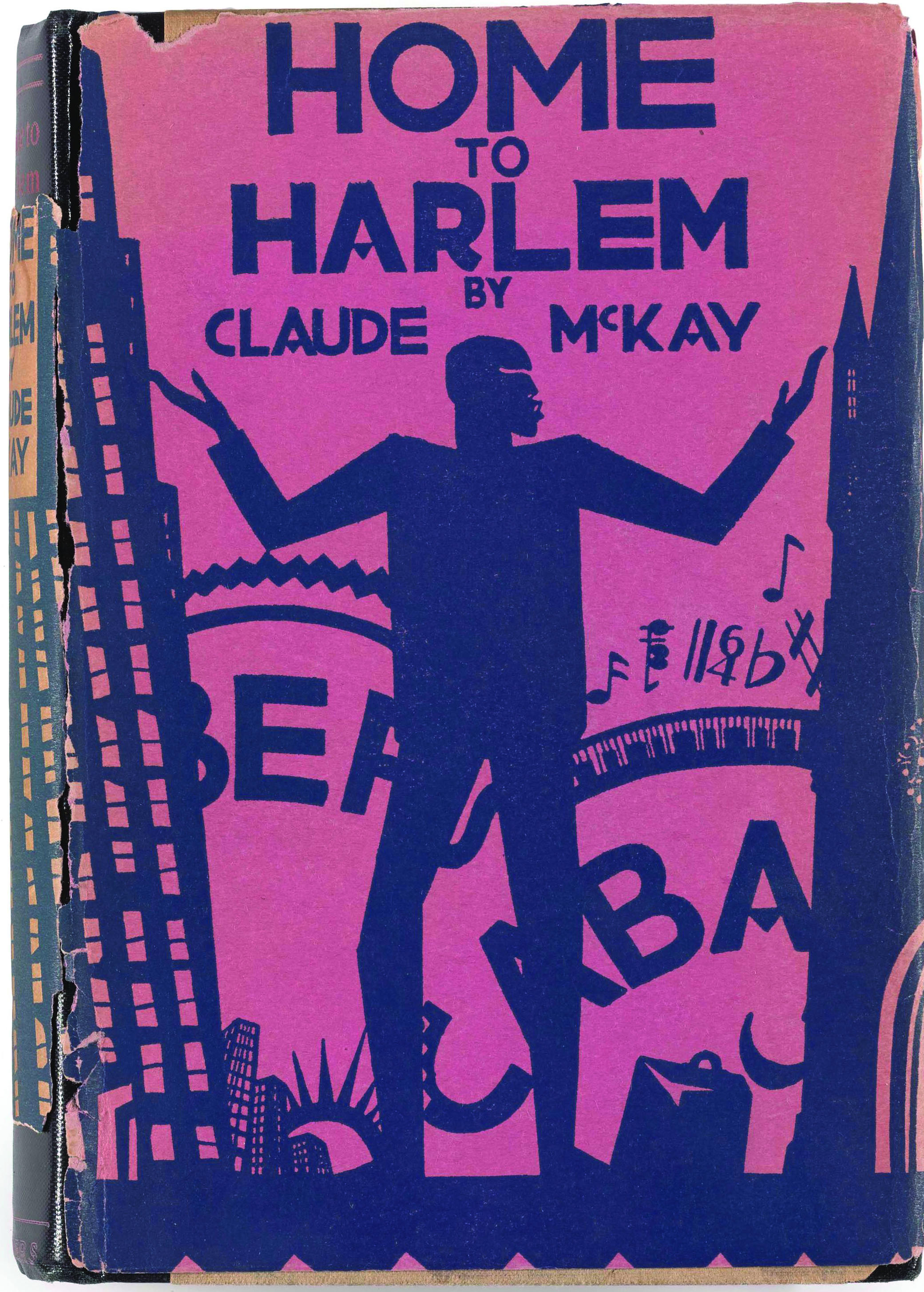
Yes, I think my first opinion about the cover was wrong. It is effective and grows on me. The Senegalese fellows at the café were enchanted with it at first sight. Maybe my plastic sense is a little corrupt and sentimental.8
By understanding the dialogue between Douglas’s illustrations and the texts they accompany, we can better understand how writers and artists of the New Negro Movement together created novel modes of modernist expression rooted in the powerful aesthetics of an African past and an American present. For Douglas, the task of the Black artist was to give “creative expression to a traditionless people.”9 In his book illustrations from the 1920s and ’30s, he created a rich and dynamic iconography of modern Black life, one that continues to inspire artists today.
Caroline Culp is Adjunct Assistant Professor of Art History.
Notes:
1 For an excellent collection of in-depth studies on the artist, see Susan Earle, ed., Aaron Douglas: African American Modernist (New Haven: Yale University Press, 2007).
2 The White population, by contrast, grew only 20 percent during these years.
Mark R. Schneider, “We Return Fighting”: The Civil Rights Movement in the
Jazz Age (Boston: Northeastern University Press, 2002), 21.
3 An excellent analysis of this image can be found in Kobena Mercer, Alain Locke and the Visual Arts (New Haven, CT: Yale University Press, 2022), 27-31.
4 Alain Locke, foreword to The New Negro: An Interpretation, edited by
Alain Locke (New York: A. and C. Boni, 1925).
5 Aaron Douglas to Langston Hughes, December 21, 1925, as quoted in Caroline Goeser, Picturing the New Negro: Harlem Renaissance Print Culture and Modern Black Identity (Lawrence: University Press of Kansas, 2007), 1.
6 The same song, “Let My People Go” would later be taken up by Civil
Rights activists of the 1950s and ‘60s to highlight the incomplete struggle
for freedom and justice.
7 Claude McKay to William A. Bradley, February 2, 1928, as quoted in
Danielle Sigler, “Claude McKay and the ‘Making of Home to Harlem,’”
Ransom Center Magazine, February 23, 2010. https://sites.utexas.edu/
ransomcentermagazine/2010/02/23/claude-mckay-and-the-making-of-
home-to-harlem/.
8 As quoted in Sigler, “Claude McKay and the ‘Making of Home to Harlem.’”
9 Aaron Douglas, “The Negro in American Culture” (1936), as quoted in
Angela L. Miller, Janet Catherine Berlo, Bryan J. Wolf, and Jennifer L.
Roberts, American Encounters: Art, History, and Cultural Identity
(St. Louis: Washington University Libraries, 2008), 529.