Essay: A Brief Overview of the Harlem Renaissance by Eve Dunbar
The poet Langston Hughes, reflecting in his autobiography The Big Sea (1940), writes that the Harlem Renaissance was a “period when the Negro was in vogue.” Hughes’s reflection captures the seeming explosion of Black cultural production from the 1920s to the mid-1930s, as well as the fleetingness of that explosion. From Jean Toomer’s Cane (1923), which sits at the intersection of American modernism and the Harlem Renaissance, to George Schuyler’s genre-bending novel Black No More (1931), a diversity of literary forms, political concerns, and artistic visions characterize the period. While we now primarily refer to the time as the Harlem Renaissance, many artists might have called it the “New Negro Movement” or simply the “Negro Renaissance.” What remains true regardless of the name one uses for the period is that Black cultural production—literature, dance, stage, music, and the visual arts—experienced an increased significance in American culture.
More specifically, the writers collected for Vassar Library’s Beauty Out of the Ashes: Printed Works of the Harlem Renaissance, 1923-1936 exhibit offer a glimpse into the varied concerns of writers and artists via their printed works. The Beauty Out of the Ashes exhibit reminds us that the Harlem Renaissance was the first time in American literary history that many Black writers could access mainstream publishing houses and magazines. So Hughes’s statement on “the vogue” of Black art reveals a story of literary access as much as it shows an explosion of artistry.
Access to mainstream publishing promised Black writers some influence over the general public’s understanding of Black art and life. Most writers sought to move away from caricature toward more fully developed portraits of the complexity of Black life. The movement toward complexity did not necessitate an erasure of the US’s ugly racial history, which might take the form of ignoring racially offensive language and images. For some Black writers, engagement with offensive and uplifting language was central to the politics of self-determination for Black artists. Then, like now, Black writers were faced with the difficult task of navigating American racism and staying true to their artistic visions.
Alain Locke was the most successful at articulating the significance of the period as it was developing. A professor of philosophy at Howard University in Washington, DC, Locke edited the groundbreaking anthology The New Negro (1925), which collected the writings of established and up-and-coming Black artists, activists, and thinkers writing on Blackness in the United States and internationally. As he pronounces in his foreword to The New Negro, the anthology is a collection “of” Black Americans, not “about” them. This distinction may appear minor, but it signals the epochal turn from an older, externally formulated representation of Black people in the United States (the Old Negro) to the self-representation of Black people (the New Negro) through art. The Old Negro, Locke writes in his introduction to the volume, “was a creature of moral debate and historical controversy” and “a stock figure perpetrated as a historical fiction.” At the same time, the New Negro is a “collaborator and participant in American civilization.” The difference is stark in as much as Locke’s “Old Negro” is history, and the “New Negro” is the present and future imagined as fully integrated and integral to American society, no longer marginalized by race or region. Thus, Locke’s New Negro anthology centralizes the creative genius of Black writers and artists as essential to any form of racial progress the nation seeks.
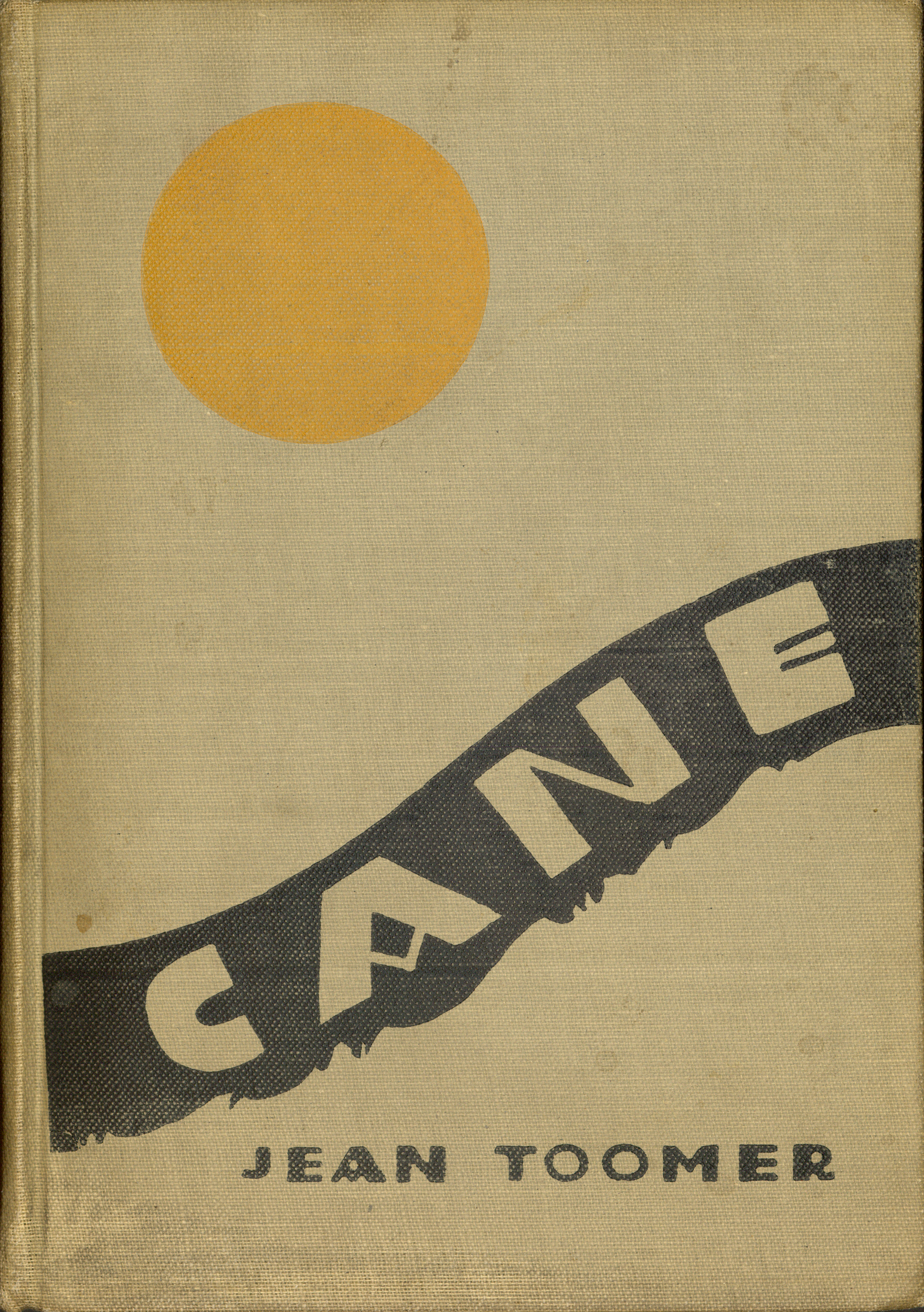
Perhaps one of the most well-known and artistically sophisticated literary texts to emerge from the Harlem Renaissance is Jean Toomer’s Cane (1923), which appeared two years before Locke would announce the New Negro Movement (Fig. 1). One reason this book exhibit begins with Toomer’s Cane is that in 1923, Cane was the first novel by an African American published by a major publishing house in over a decade. This alone would warrant some notice, but Toomer’s text is a testament to Black literary experimentation. Though considered a novel, Cane consists of poetry, fiction, drama, and visual art, marking the text as one of the Harlem Renaissance’s most formalistically innovative works. Vacillating between motifs of beauty and violence, Cane imagines the American South and North as dynamically held in tension as the nation sits on the cusp of catastrophic change.
Toomer’s three months serving as acting principal at an agricultural school catering to Black students in the rural town of Sparta, Georgia inspired the writing of Cane. While living in Georgia, Toomer encountered a Black experience alien to him as someone who grew up between Washington, DC and New York City. This regional difference prompted him to describe Cane as a “swan song” to a people and a way of life he felt was fading due to industrialization, the Great Migration, and promises of national integration. For instance, in the third stanza of Cane’s “Song of the Son” the speaker laments the end of a version of rural Black life:
In time, for though the sun is setting on
A song-lit race of slaves, it has not set;
Though late, O soil, it is not too late yet
To catch thy plaintive soul, leaving, soon gone,
Leaving, to catch thy plaintive soul soon gone.
One sees in these lines anticipation of the end of a way of life; the setting sun is a visual metaphor for the darkness awaiting this place and its people in Toomer’s mind.
The days leading up to the Harlem Renaissance were some of the darkest for African Americans. By 1919, about 500,000 Black Americans had made their way from the rural South to resettle in the industrialized North and Midwest as part of the Great Migration. Enticed north by the promise of better-paying employment and freedom from Jim Crow, many of the immigrants found in the North a continuation of the racial violence and exclusion they experienced in the South. In fact, the summer of 1919 was a watershed moment of anti-Black violence in the United States during the 20th century. Called the “Red Summer” for the blood spilled, race riots broke out in over 26 US cities. The Ku Klux Klan also had a revival in the 1920s, growing into a nationwide organization with chapters from Maine to Oregon and a membership estimated to be between 2.5 to 4 million. White animus regarding perceived African American mobility, fear of racial proximity, and Black access to a desegregated American experience prompted much of the anti-Black violence of the 1920s.
Claude McKay’s sonnet “If We Must Die,” which first appeared in the July 1919 issue of the left-leaning The Liberator magazine, might offer some vision of Black resistance to the wholesale violence of White supremacy afoot during the period. McKay, whose later work is on display in this Beauty Out of the Ashes book exhibit, writes:
If we must die, let it not be like hogs
Hunted and penned in an inglorious spot,
While round us bark the mad and hungry dogs,
Making their mock at our accursèd lot.
If we must die, O let us nobly die,
So that our precious blood may not be shed
In vain; then even the monsters we defy
Shall be constrained to honor us though dead!
O kinsmen! we must meet the common foe!
Though far outnumbered let us show us brave,
And for their thousand blows deal one death-blow!
What though before us lies the open grave?
Like men we’ll face the murderous, cowardly pack,
Pressed to the wall, dying, but fighting back!
The speaker of McKay’s poem argues for resistance to the onslaught of death facing the “we” of the poem. Calling for bravery and a “death-blow” to the aggressors that outnumber them, “If We Must Die” would be reprinted throughout the 20th and 21st centuries as a call to resistance among Black activists. The poem, then, stands as a testament to the power many Black writers felt able to wield through their artistic visions during the Harlem Renaissance.
Similarly, Langston Hughes, among the most well-known and successful writers during the Harlem Renaissance, would use poetry to reimagine and critique the nation in his poem “Let America be America Again.” Published in 1936, this poem bookmarks the Harlem Renaissance. The opening stanza reads:
O, let my land be a land where Liberty
Is crowned with no false patriotic wreath,
But opportunity is real, and life is free,
Equality is in the air we breathe.
Hughes, known for his innovative vernacular and blues-based poetry, chooses a more traditional voice for this poem, perhaps to signal the gravity of his critique and his capacity to speak to and for all Americans feeling marginalized during the Depression years in the United States. The stanza signals the speaker’s capacity to conjure a land where the ideals of the nation—opportunity, equity, and freedom—are easily accessed by all inhabitants of the country. Speaking for White Americans, laborers, and Native and Black peoples, the speaker hopes for inclusion and access to the radical vision of democracy. In this vein, the poem’s closing stanza offers critique and promise:
O, yes,
I say it plain,
America never was America to me,
And yet I swear this oath—
America will be!
Hughes captures the dissatisfaction experienced by many of the marginalized. He also, however, captures the oath of the poem’s discontented speaker to bend the nation towards its ideals: “America will be!” Unlike McKay’s “If We Must Die,” “Let America Be America Again” holds a space for a future outside of Black death.
The period’s daring capacity to critique and imagine the nation anew made many of the Harlem Renaissance writers targets of the United States government in the form of J. Edgar Hoover’s Federal Bureau of Investigation (FBI). In 1919 the FBI published a report titled Radicalism and Sedition among the Negroes as Reflected in their Publications, citing McKay’s “If We Must Die” as the sort of anti-American work worthy of suspicion. The FBI is known to have opened files on 51 Black writers between 1919 and 1972, Claude McKay being their first. The FBI’s interest in Black writers highlights the radical power of Black writing that began during the Harlem Renaissance.
Because an artist’s life often favors those of class privilege, many critical African American writers found financial support for their craft among wealthy White patrons and well-connected White interlocutors. One of the most infamous patrons was a woman named Charlotte Osgood Mason, a wealthy New York socialite. Mason is known to have supported the work of Alain Locke, Langston Hughes, and Zora Neale Hurston, among other Black writers. However, the price of her support was primitivism, a belief that Black people did not develop along the same trajectory toward modernity as White Americans. Mason expected “authentic” Black voices but only recognized those voices that fit the primitive mold she desired. Hughes and Locke would break with Mason over these demands earlier than Hurston, but all of these writers ultimately shifted away from Mason to tell more accurate stories of Black life than she was willing to pay to hear.
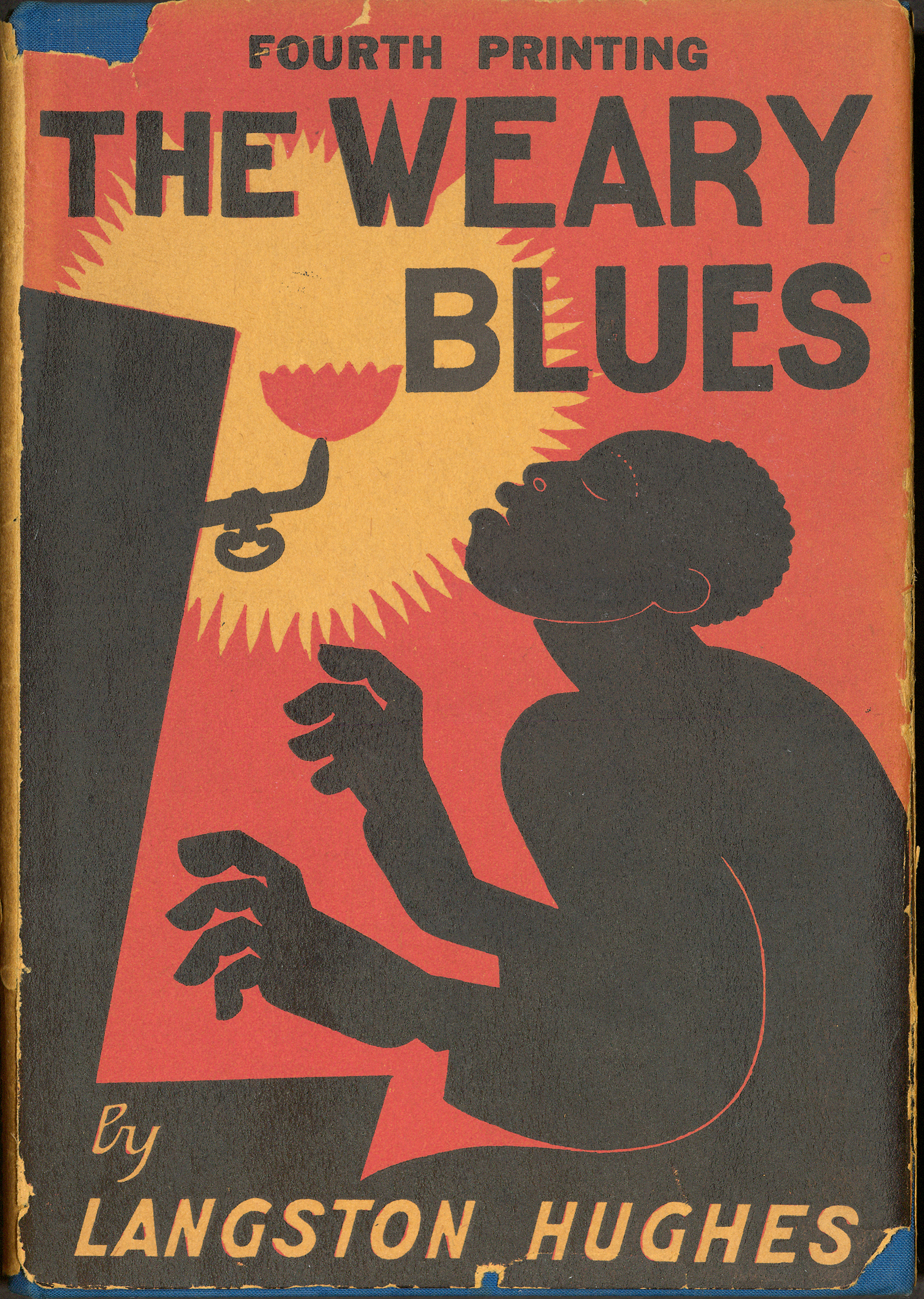
Carl Van Vechten is another White interlocutor of note among many Harlem Renaissance writers. A writer and cultural critic, Van Vechten was a passionate and dedicated consumer of Black art from the Harlem Renaissance and beyond. Unlike Mason, Van Vechten was more of a facilitator than a dictator. He was not, however, without his racial issues that came in the form of his bestselling novel, Nigger Heaven (1926). W.E.B. Dubois is said to have hated the novel, a hyperbolized depiction of Black life in Harlem. Despite the offense of his novel’s title and content, Van Vechten was key to getting Langston Hughes a contract for The Weary Blues (1926) with the mainstream publisher Alfred A. Knopf (Fig. 2). He facilitated Nella Larsen’s publication of her novels Quicksand (1928) and Passing (1929) with Knopf. Van Vechten was also a supporter of Zora Neale Hurston’s career while she lived in New York City. In short, he was a White person one would have liked to know if one wanted to become a published writer.
Black women and queer writers would find an important voice during the Harlem Renaissance. The period was changed by writers like Nella Larsen, Zora Neale Hurston, Wallace Thurman, Claude McKay, and many others who did not identify as heterosexual men and wrote about the lives of people who were also not men or straight. The publication Fire!!: A Quarterly Devoted to Younger Negro Artists (1926), which appears in this book exhibit, introduced many of these younger writers. Their literary perspectives run counter to the normative and respectable writers that came before them, many of those writers anthologized in Locke’s New Negro.
Edited by Wallace Thurman and featuring the works of Zora Neale Hurston, Langston Hughes, Countee Cullen, Helene Johnson, Arna Bontemps, and others, Fire!! promised to burn the soul of its readers. The magazine opens with Thurman’s short story, “Cordelia the Crude,” which follows a young man who believes he is the cause of a young woman’s turn to prostitution. The titular Cordelia, however, has no qualms about the guy who gave her her “firs’ two bucks….” Likewise, Hurston’s short play, Color Struck, publicly explores colorism, or the Black community’s privileging of those Black people with skin tones most proximate to White people. Finally, Richard Bruce Nugent’s stream-of-consciousness story “Smoke, Lilies and Jade” follows Alex, a young Black man struggling to live up to his family’s expectation that he give up his dreams of being an artist to earn a living. Alex decides between a life of normativity in the form of romance with his girlfriend, Melva, or one of passion and love with a man named Beauty. In the end, Alex appears to choose Beauty. Taken as a whole, the young writers of the Harlem Renaissance expressed the dynamism of the Black experience in new and innovative ways.
Many argue that the Great Depression dried up all the White money supporting Black artists, thereby ending the Harlem Renaissance. This assertion remains debatable as many of the writers of the period continued to produce work into the 1940s. It is more useful to think of the period’s end as a transition to a new era in African American literature. Rather than the lack of White money, a newer generation of Black writers developed at a different historical and cultural moment and sought to differentiate themselves from the previous generation. This claim is best illustrated by a writer like Richard Wright.
Richard Wright’s 1940 novel Native Son was the first book authored by an African American to be a Book-of-the-Month Club selection, which secured his place as the most significant and essential Black writer of the 1940s and 1950s in the United States. But in 1937, while still an up-and-coming writer, Wright wrote an essay entitled “Blueprint for Negro Writing” that would shape the African American literary production for the following decade. In “Blueprint,” Wright contends the previous generation of Harlem Renaissance writers “went a-begging to white America…dressed in the knee-pants of servility.” Wright’s assessment centers on his sense of the writers as too compromised by White patronage to do the politically radical work of Black liberation through art. Yet he wrote this essay for a literary magazine, The New Challenge, started by Dorothy West, one of the youngest members of the Harlem Renaissance.
Thus, what we hope to illustrate with Beauty Out of the Ashes: Printed Works of the Harlem Renaissance, 1923-1936 are the varied and vexed concerns writers of the period had for the publishing world. From the Great Migration and the Red Summer of 1919 to the increased impact of Black women and queer people writing their lives amid modernity, the Harlem Renaissance was a time of great innovation and change. The writers of the period shifted the African American literary landscape throughout the 20th century. Moreover, the labels written by the students of Vassar’s English 319: Renaissance and Revolution exemplify a commitment to thinking about the way African American literature might speak to the 21st century.
Eve Dunbar is Professor of English on the Jean Webster Chair.