Bons Baisers de France
An English version of the Sorbonne website caption, for the new section on French Postcards, "Bons Baisers de France"
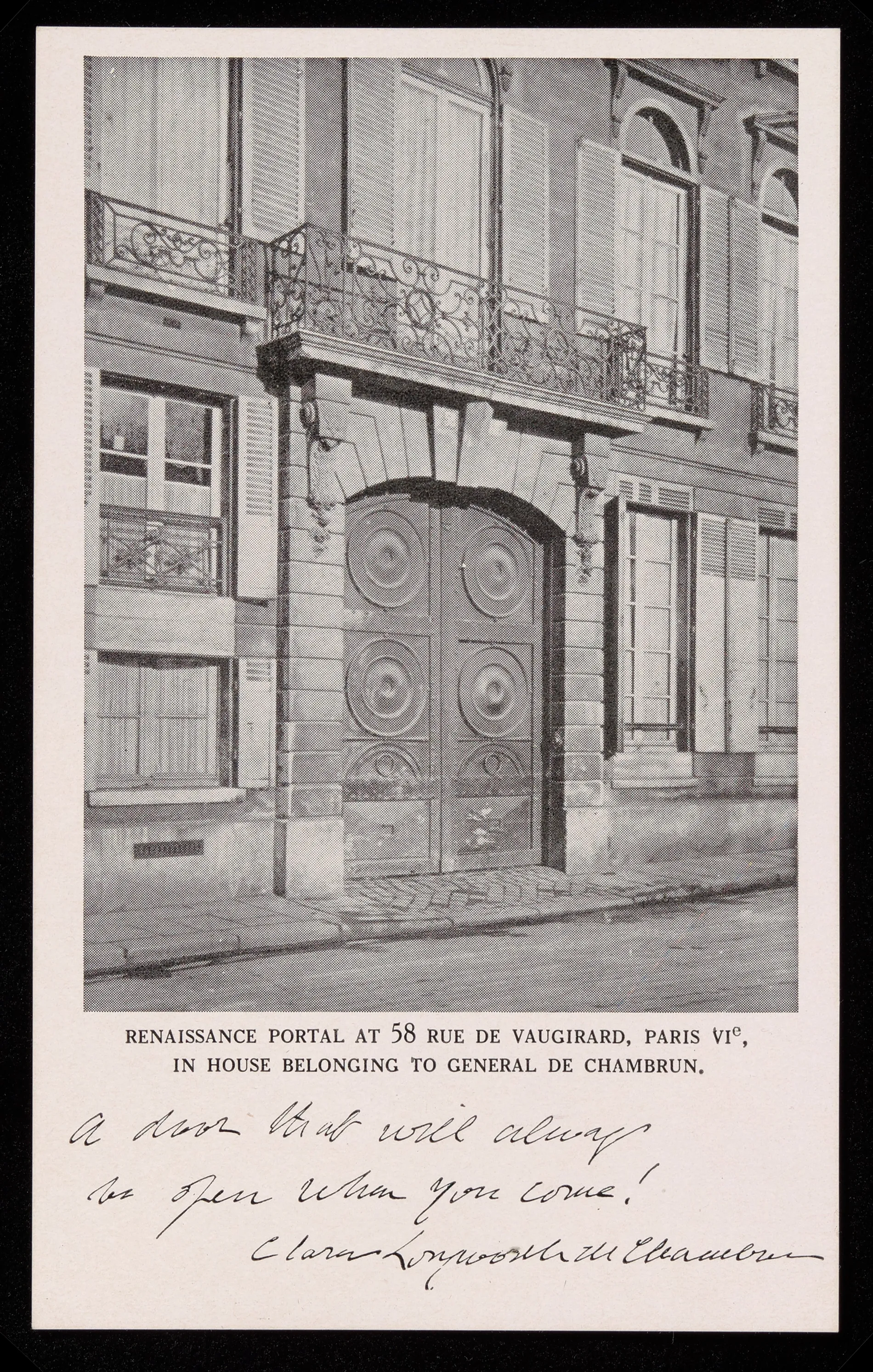
Elizabeth Bishop took two post-graduation trips to France in the mid-1930s. On her first trip to Paris in 1935, she travelled with Vassar classmate Harriet “Hallie” Tompkins on a Nazi ship, objecting to the “German tourists” on board (see here). The two friends visited Paris and Versailles before relocating to the Brittany fishing village of Douarnenez. In autumn Bishop returned to Paris where she met up with another Vassar friend, Louise Crane. Bishop and Crane lived in an apartment at 58 Rue de Vaugirard, a home owned by Crane family friends the General and Comtesse de Chambrun. A postcard of the home’s “Renaissance portal” includes Mme de Chambrun’s handwritten caption, “A door that will always be open when you come!” Bishop and Crane made a second trip to Europe in 1937, arriving in France after spending two months travelling in Ireland and England. Mutual friend Margaret Miller joined Bishop and Crane to tour Burgundy by car, but a car accident in July resulted in the amputation of Miller's right arm, a traumatic event that curtailed their trip. Bishop returned to New York via Genoa just before Christmas.
While in France Bishop began translating French poetry, especially Rimbaud, explored Surrealist art and writing, and attended a variety of museums, concerts, and performances, including a lecture by Gertrude Stein. Bishop was well aware of the 1920s Anglo-American modernist scene in Paris, and of her belatedness in travelling to France in the 1930s (One Art 32). One generation younger than Stein, Bishop assured her friend Frani Blough Muser that "I am not, never, never, an EXPATRIATE" (One Art 37). Despite this disclaimer, Bishop’s travels in France were a time of great artistic growth and experiment, establishing aesthetic interests and habits that she would explore over her long career, and providing what poet John Ashbery called “the mooring of starting out” (“Soonest Mended”).
While Bishop toured key locations of avant-garde Paris and met many of its leading figures, she preferred the position of outsider looking in, her gender, queerness, and feminist beliefs all contributing to her wariness of the male-dominated avant-garde, an attitude that would influence her lifelong distrust of any artistic group, movement or school. Experiment for Bishop was carried out in her own terms, characterised by an aesthetics of unconventional perspectives, obscured views, and juxtapositions of subject and scale, all evident in the picture postcards she mailed from France. For instance, a historical postcard of the statue of Joan of Arc on the Rue Rivoli centers not on the statue of Joan on her horse, but on pedestrians crossing the street who have momentarily paused to avoid carriage traffic, a daily modern battle. The interior of Chopin and George Sand’s house in Mallorca features a receding door that leads out into a garden with a stone pathway to a well, promising and denying entry, like the postcard form itself.
In France Bishop cultivated an interest in photography, and developed her lifelong habit of collecting and sending postcards, often included with letters in envelopes, as a means of curating and commenting on images and what she called “the eye of the camera.” In a postcard to Margaret Miller of the lobby of the Hôtel des Saints Pères in Paris, Bishop declares that the photograph “must have been taken with intense flashlight-photography.” She collected antique cards, as in the “Bonne Année” photocard of a person of ambiguous gender holding roses. She participated in the popular French practice of creating postcard images, posing with Louise Crane as a pair of male boxers on a photocard.
Bishop never returned to France after 1937 (although in 1949 she visited Port-au-Prince, Haiti, where she was able to “work on her French”). But she often reflected upon her time in France, especially Paris, and continued to send postcards featuring French art. She sent multiple cards featuring the works of Jean-Baptiste Camille Corot, Gustave Courbet, Henri Matisse, and Nicolas Poussin. One of her own paintings appears to have been modelled on Odilon Redon’s “Large Green Vase with Mixed Flowers” (Vassar 26.36/37). In 1962, she dreamed of flying to Paris on the wings of a kite, and on a postcard of a busy intersection in San Francisco’s Chinatown from the late 1960s, she comments: “The reason I never speak, or dream, of Paris is because I haven’t the money to get there & certainly not to stay there” (Vassar 31.1-8 16/17).