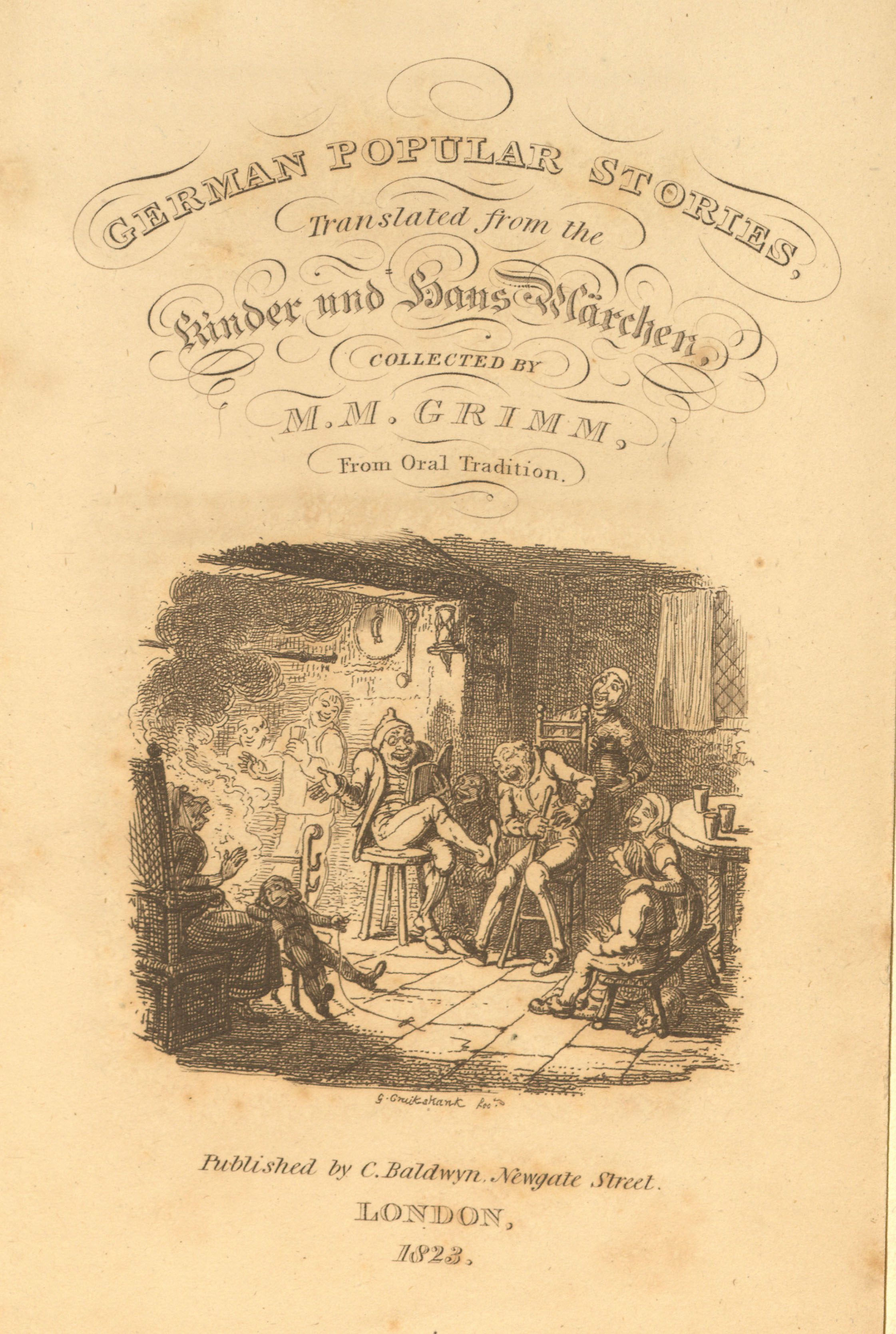
Figure 9: Title Page of the First English Edition of Grimms’ Tales
1 media/2025_GermanPopularStories_thumb.jpg 2026-02-13T21:52:11+00:00 vclibrary 4b567aa9ea15046df7ed5f9e846949edf9240acb 13 2 plain 2026-02-16T19:54:33+00:00 1815 Title Page of the First English Edition of Grimms’ Tales (illustrated by George Cruikshank). vclibrary 4b567aa9ea15046df7ed5f9e846949edf9240acbThis page is referenced by:
-
1
2026-02-16T17:29:11+00:00
Essay: Sendak’s Grimm by Elliott Schreiber
8
plain
2026-02-16T21:06:28+00:00
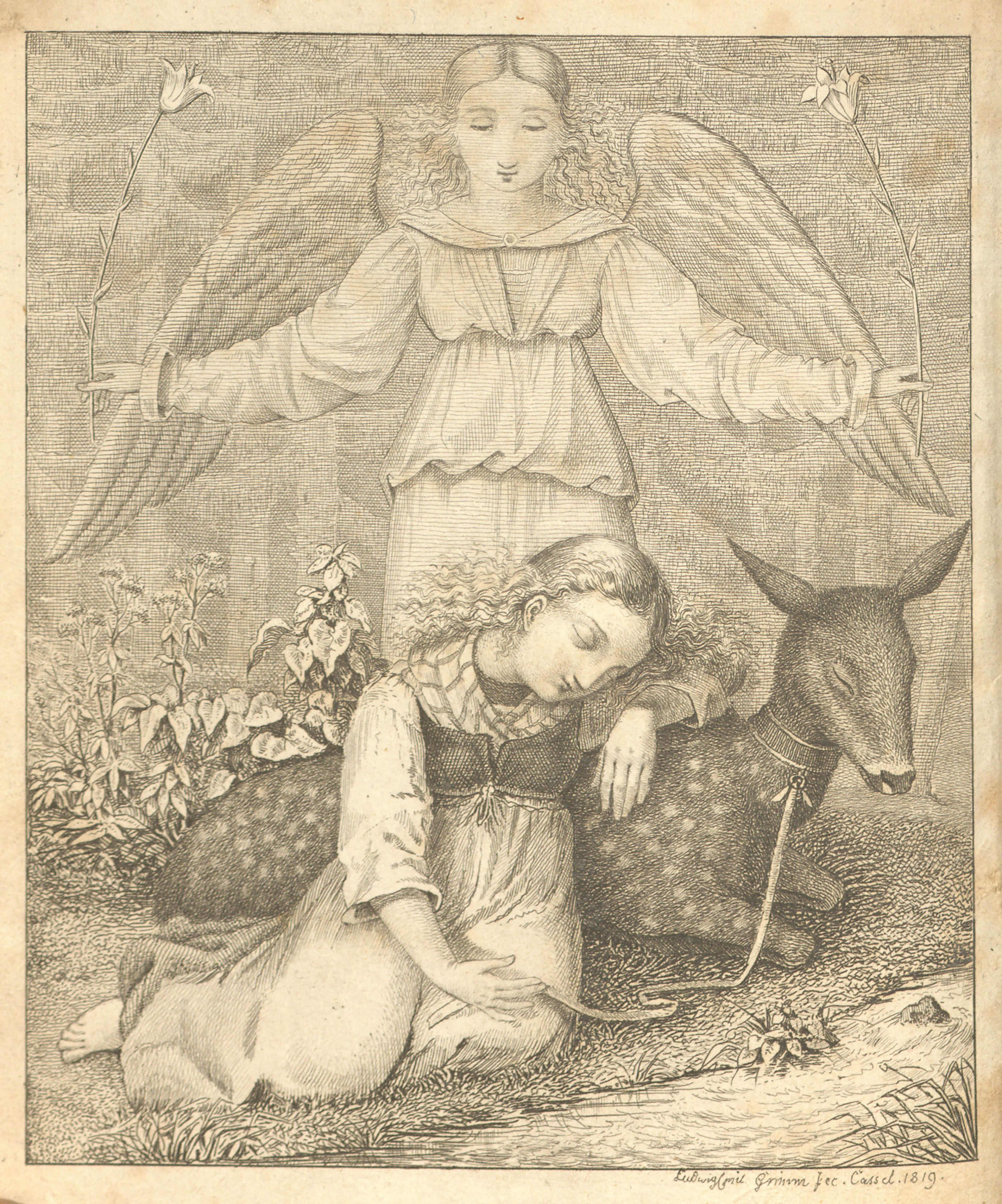
Without the work of countless illustrators, the Brothers Grimm would very likely not be the house-hold names that they are today. Indeed, it was the commercial success of the first illustrated edition of a selection of their tales, published in England in 1823 (with pictures by George Cruikshank) that first made Jacob Grimm (1785–1863) and Wilhelm Grimm (1786–1859) aware that their Children’s and Household Tales (Kinder- und Hausmärchen) had the potential to reach a large German-speaking readership, as well (see Fig. 9). The extensively annotated first edition of their tales (1812/1815) sold well enough that the Grimms published an updated second edition in 1819, but neither edition was a bestseller. The English edition helped inspire the Grimms to publish, in 1825, their own “small edition” (“kleine Ausgabe”) of 50 tales and to make it available in both a less expensive, text-only format as well as in a pricier, illustrated format. With this and with each of the subsequent editions of their tales that they published in their lifetimes (totaling seven full and ten small editions), their German-speak-ing readership grew in tandem with their international renown.¹ While Cruikshank may have been the first illustrator to truly popularize Grimms’ tales, credit for the very first illustration of one of their tales goes to their younger brother, Ludwig Emil Grimm (1790–1863), whose illustration of “Brüderchen und Schwesterchen” (“Little Brother and Little Sister”) served as a frontispiece for the first volume of the tales beginning with the second German edition (see Fig. 10), and who also created the seven illustrations for the small edition. A copy of the second edition, acquired in 2025 by Vassar College Library’s Special Collections, is a cornerstone of the present exhibit. Making this particular copy all the more noteworthy is the fact that it belonged to Maurice Sendak (1928–2012), one of the premier illustrators of Grimms’ tales of our time.²
Sendak is best known as the author-illustrator of modern classics for children, including Where the Wild Things Are (1963) and In the Night Kitchen (1970), picture books that radically expanded the thematic and stylistic possibilities of the genre. One way that they did so was by exploring the more frightening, but also more exhilarating dimensions of childhood. In his 1964 acceptance speech for the Caldecott Medal, awarded to him for Wild Things, Sendak notes that his books attempt to convey a “vision of the truth” about childhood (Caldecott & Co. 150), one at odds with those children’s books that he accuses of “endless pussyfooting about the grim aspects of child life” (153). As Sendak explains, “The realities of childhood put to shame the half-true notions in some children’s books. These offer a gilded world unshadowed by the least suggestion of conflict or pain, a world manufactured by those who cannot—or don’t care to—remember the truth of their own childhood. Their expurgated vision has no relation to the way real children live” (153).
Sendak was aware that this “expurgated vision” of childhood was not merely a product of post-War America, but rather had its origins in “the great nineteenth-century fantasy that paints childhood as an eternally innocent paradise” (153). But Sendak was also keenly aware of another, and in his view more truthful current of nineteenth-century children’s books. Thus, he opens his acceptance speech with an encomium to the award’s name-sake, the illustrator Randolph Caldecott (1846–86), remarking, “Caldecott never tells half-truths about life, and his honest vision, expressed with such conviction, is one that children recognize as true to their own lives” (149). And it’s quite possible that Sendak’s reference later in his speech to “the grim aspects of child life” is an allusion to the Brothers Grimm, whose name was a ready source for puns beginning in their own lifetimes (Schmiesing 5, 220). Be that as it may, in a short essay published in the same year (1964) as his Caldecott acceptance speech, Sendak explicitly cites the Grimms (along with Hans Christian Andersen) as exemplars of what he regards both as a more truthful as well as more engaging form of writing for children. “Clearly,” he notes, the Grimms and Andersen “never bothered their heads about providing so-called healthy or suitable literature for children. How fortunate for us they were only interested in telling a good story! And they are stories charged with originality and a tremendous understanding of the fascinating tangle of life” (Caldecott & Co. 158).
When Sendak penned these words in 1964, he had yet to publish any illustrations of Grimms’ tales.³ However, two years prior, he had been approached by Michael di Capua (who would be-come his editor and close friend for the next fifty years) with the idea for a new project: illustrating an edition of selected tales by the Grimms. This edition would eventually appear in two volumes in 1973, titled The Juniper Tree and Other Tales from Grimm. That same year, Sendak also brought out an illustrated edition of Grimms’ tale “King Grisly-Beard.” ⁴ In 1981, he published Outside Over There, which he regarded as part of a trilogy with Wild Things and Night Kitchen (Lanes 227). While an original work, it draws on tales in Juniper Tree, especially “The Goblins.” Six years later, Sendak’s picture-book version of a hitherto unpublished tale by Wilhelm Grimm appeared, entitled Dear Mili (1988). Finally, his set and costume designs for a 1996 production of Engelbert Humperdinck’s opera Hansel and Gretel have just been incorporated into a picture book, paired with Stephen King’s retelling of the Grimms’ story, which Sendak first illustrated for Juniper Tree. In short, Sendak’s engagement with Grimms’ tales, beginning with the foundational Juniper Tree project, was extensive. It was also, as even a cursory glance at his Grimm-related publications reveals, quite varied, from the playful drawings of King Grisly-Beard to the somber watercolors of Dear Mili. Despite Sendak’s “chameleon-like ability” to shift styles, as Jonathan Weinberg puts it (20), each of these works is instantly recognizable as Sendak. In di Capua’s words, “His fingerprints were everywhere.” ⁵
When di Capua pitched his idea of an edition of Grimms’ tales to Sendak in 1962, he was captivated not only by Sendak’s range and artistry, but also by his enthusiasm for German romantic literature and culture, an enthusiasm that di Capua shared.⁶ Originally, di Capua hoped that Sendak would collaborate with the poet and translator Randall Jarrell on Juniper Tree. The project was delayed, however, by Sendak’s work on two other books by Jarrell,⁷ before being put on hold indefinitely by Jarrell’s death in 1965. Di Capua eventually invited Lore Segal to work with Sendak on the collection, having edited her picture book, Tell me a Mitzi (1970, illustrated by Harriet Pincus). Segal, who passed away in 2024, is perhaps best known for her autobiographical novel, Other People’s Houses (1964), which recounts the story of a girl who flees to Great Britain on the British Kindertransport rescue operation in the wake of the 1938 annexation of Austria by Nazi Germany. Di Capua recalls that Segal’s fluency in both her native German and in her adopted English was a prime motivating factor for his engaging her for the Juniper Tree project. She also happened to be Jewish, like Sendak, and the Holocaust loomed large in both of their lives (if more immediately for Segal). In addition, Segal shared Sendak’s unsentimental understanding of the rich emotional life of children, as her vivid portrait of the young protagonist in Other People’s Houses attests.⁸
In preparation for illustrating Grimms’ tales, Sendak under-took a research trip to West Germany in June of 1971. During this trip, he kept a sketchbook and steeped himself in German art. The postcards that he collected along the way (together with his sketchbook, they are in the holdings of The Maurice Sendak Foundation) give us insight into the artists whose work he studied during what he dubbed his “Grimm Reise” (Grimm Trip), including Albrecht Dürer, Mathias Grünewald, Caspar David Fried-rich, Ludwig Richter, Adalbert Stifter, Moritz von Schwind, and Ludwig Emil Grimm. Between December 27, 1971, and March 4, 1973, Sendak completed 27 ink drawings for Juniper Tree, one for each of the tales that he and Segal had chosen (Lanes 198). The physical dimensions, fine cross-hatching, “proscenium-like spaces” (Weinberg 42), and “statuary” look (Rölleke 243; my translation) of his illustrations lend them great cohesiveness. Their emotional spectrum, though, is wide, stretching from the whimsy of his illustration for “Hans My Hedgehog” to the disturbing, hallucinatory quality of his picture for the title story.
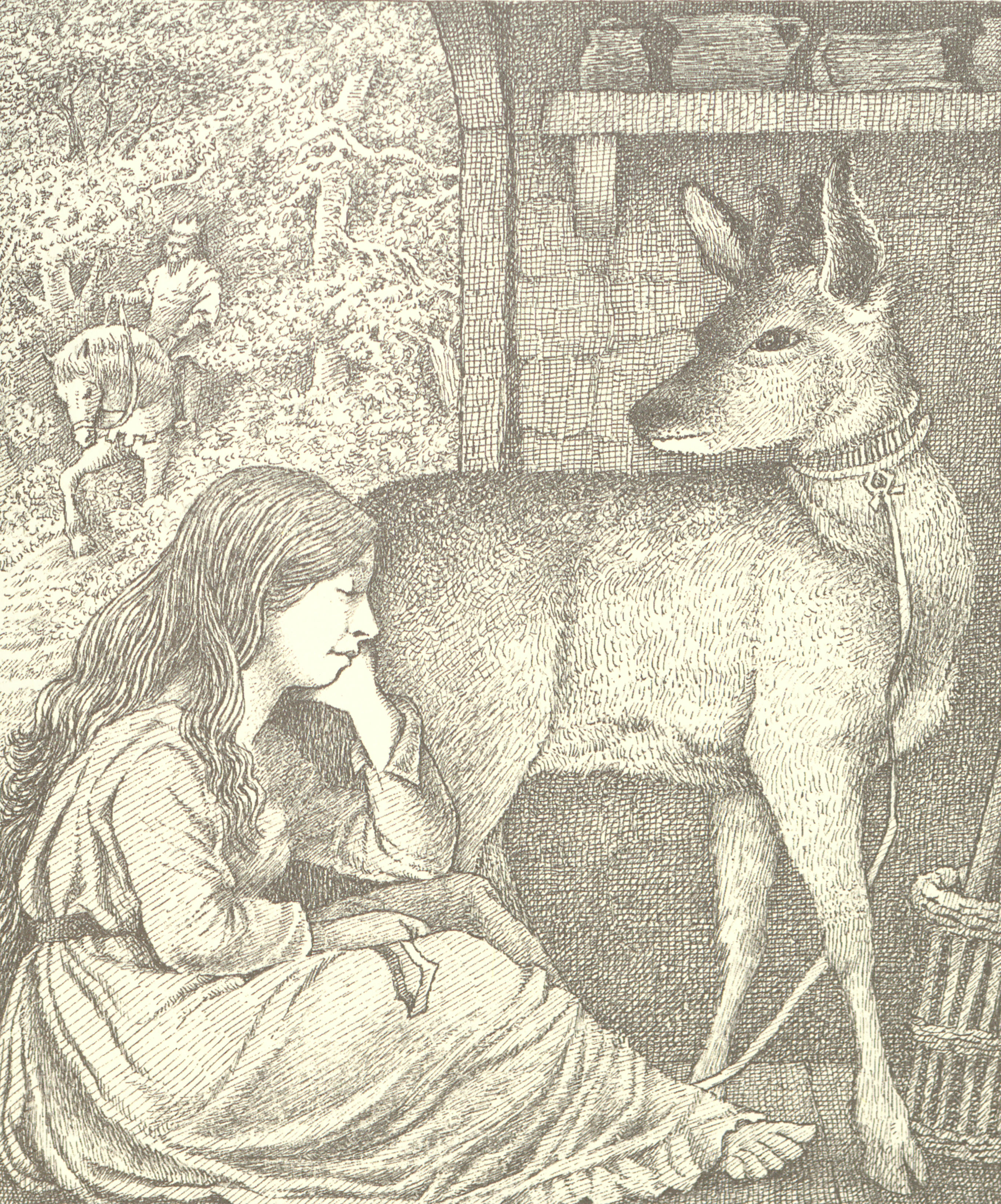
Even a single illustration in Juniper Tree can evoke a variety of seemingly contradictory emotions—the “tangle of life,” in Sendak’s words. Consider, for instance, his illustration for “Brother and Sister,” as Segal translated “Brüderchen und Schwesterchen” (literally, “Little Brother and Little Sister”). The story tells of young siblings who, while running away from their abusive step-mother through the forest, encounter a series of streams that she has enchanted. The brother eventually gives in to his thirst, drinks from the third stream, and is transformed into a fawn. In his metamorphosed form he delights in being chased by the king’s huntsmen, much to his sister’s chagrin, though he returns each evening to the little cabin in the forest where they have found shelter (see Fig. 11).
Sendak’s drawing is, on one level, an homage to Ludwig Emil Grimm’s lovely illustration of the same tale—again, the very first illustration of any of the Grimms’ tales, and one that served as a frontispiece to the second German edition that Sendak owned. Like Grimm, Sendak positions the sister and the brother (in his metamorphosed state) in the foreground. As in Grimm’s picture, the sister’s eyes are closed, and she holds a leash (made of braided reeds, as we learn in the story) that is attached to the deer’s collar (the sister’s golden garter). But despite his reverence for Ludwig Emil Grimm, several of whose prints he collected, Sendak makes a number of key changes. To begin with, he leaves out the guardian angel—a figure that appears nowhere in the tale—who stands be-hind the siblings in Grimm’s picture.⁹ Similarly, whereas Grimm’s illustration presents the siblings surrounded by nature—the grassy bank where they sit, the stream that runs beside them, the plants directly behind the fawn, the tree branches that are faintly visible in the background, and the flowers held in each of the angel’s hands—Sendak’s illustration places the siblings in an interior space (and thus at a remove from the natural world) as well as within the tight, “almost claustrophobic” (Weinberg 42) frame of the picture. In Sendak’s illustration, the sister no longer rests on the fawn; rather, her chin rests on her hand, and her elbow in turn rests on her own knee—she is literally supporting herself. In keeping with Segal’s rendering of “Brüderchen” as “brother” rather than “little brother,” Sendak portrays him not as a spotted fawn, but rather as a vigorous young deer with budding antlers. In his transmogrified form, then, he is further metamorphosing into a button buck or adolescent deer. In addition, in contrast to Ludwig Emil Grimm, Sendak does not depict him lying down with eyes closed, but rather standing and alert; perhaps he spies the king on horseback, visible in the open doorway, and is eager to join the hunt. To be sure, Sendak does portray a deep bond between brother and sister; note, for instance, the way that the line of deer’s leash continues in the crease of the sister’s dress, subtly connecting the siblings. But Sendak’s vision of intimacy is infused with an almost existential loneliness; the brother and sister are neither watched over by a guardian angel nor comforted by their natural environment, and despite their close bond, each seems to be immersed in her or his own world. It is thus fitting that the specific passage of the story to which Sendak links his illustration (included in the list of pictures after the table of con-tents) reads, “And so it went for a while, that they were all alone in the wilderness.” While Sendak’s illustration suggests his affection for, and his debt to, Ludwig Emil Grimm,¹⁰ he also illuminates emotional crosscurrents running through the text that Grimm’s tender illustration does not accentuate as strongly.
When it appeared in the Fall of 1973, The Juniper Tree was a critical sensation. In her review in the November 4 issue of The New York Times Book Review, novelist and critic Allison Lurie praised Segal and Sendak for their unorthodox selection of tales, and remarked perceptively of Sendak’s illustrations, “They are visions of another and in some ways realer world than this, a dream—or nightmare—world certainly [...]. They have beauty, too, but it is a beauty that sometimes merges into the terrify-ing […]” (26). Given its nightmarish elements, Lurie portrays Segal and Sendak’s edition of the Grimms’ tales as decidedly “for grownups” (26). Three weeks after the appearance of her review, Sendak published his own review of another book on the front page of the November 25 edition of The New York Times Book Review. Though he doesn’t mention Lurie, Sendak’s review can be read both as an affirmation of her characterization of Juniper Tree, and as a rebuttal of her portrayal of its target audience. The subject of Sendak’s review is an anthology of comic strips by Winsor McCay. In the review’s first paragraph, he places Mc-Cay’s comic strip Little Nemo in Slumberland in the company of “the best books for children” such as Alice in Wonderland and “the Grimm tales” (Caldecott & Co. 77). Using language that resonates strongly with Lurie’s description of his illustrations of these tales, Sendak writes that Little Nemo “is a catalogue of nightmares, a profusion of extreme fantasy images rendered with such explicit definition that the dream is captured in all its surrealistic exacti-tude” (78). According to Sendak, though, these nightmarish and surrealistic qualities don’t make Little Nemo inherently unsuitable for children. Rather, Sendak continues, “There are many details that I suspect only children see, and those rare adults who still look with a child’s intelligent curiosity” (78). Here as through-out his work, Sendak places great faith in children’s intelligence, including their emotional intelligence, and challenges adults to revise their half-true notions of children as well as of the best literature and art that has been made for them.
Mr. Schreiber is Professor of German Studies and Director of the Global Nineteenth-Century Studies Program.
- On the publication and reception history of Grimms’ tales, see Annhmiesing, The Brothers Grimm: A Biography.
- I would like to express my gratitude to Jonathan Weinberg, Nathan Fils, Lynn Caponera, and their colleagues at The Maurice Sendak Foundation, as well as to Michael di Capua, for generously sharing their time and expertise about all things Sendak.
- His illustrations of seven tales by Andersen had appeared in 1959.
- King Grisly-Beard first appeared as an insert in the magazine Family Circle
- Quoted from di Capua’s memorial speech for Sendak at the Metropolitan Museum of Art, June 12, 2012.
- Telephone interview from August 22, 2025. Sendak had at that point illustrated Dwarf Long-Nose by Wilhelm Hauff and two books by Clemens Brentano, The Tale of Gockel, Hinkel & Gackeliah and Schoolmaster Whackwell’s Wonderful Sons.
- These books by Jarrell are The Bat-Poet (1964) and The Animal Family (1965). August 1973 and subsequently (with colored pictures) in book form.
- "In my interview with him, di Capua remembered how he functioned as “ringleader,” asking Sendak and Segal to read through all 210 of Grimms’ tales, and to select their favorites. The tales that they both selected were automatically included in the collection; di Capua then asked them to each re-read the additional stories chosen by the other, and to highlight those that they liked best."
- "A guardian angel reappears in Sendak’s illustrations for Dear Mili, albeit in a much smaller and less reassuring form, as well as in his set designs for Hansel and Gretel, another story of a brother and sister who have to fend for themselves in a forest."
- "Additionally, his illustration for “The Devil and His Three Golden Hairs” quotes Ludwig Emil Grimm’s famous portrait of one of the Brothers’ most important informants, Dorothea Viehmann (who was the source for this tale), from the frontispiece to the second volume of the 1819 edition of their tales."