Ilse Schreiber-Noll Exhibition Gallery Exhibition Checklist “Nature and Nature Defiled”: Vassar Library’s Latest Exhibition - written by Angelina Papa Events Copyright © 2022 Vassar College Libraries
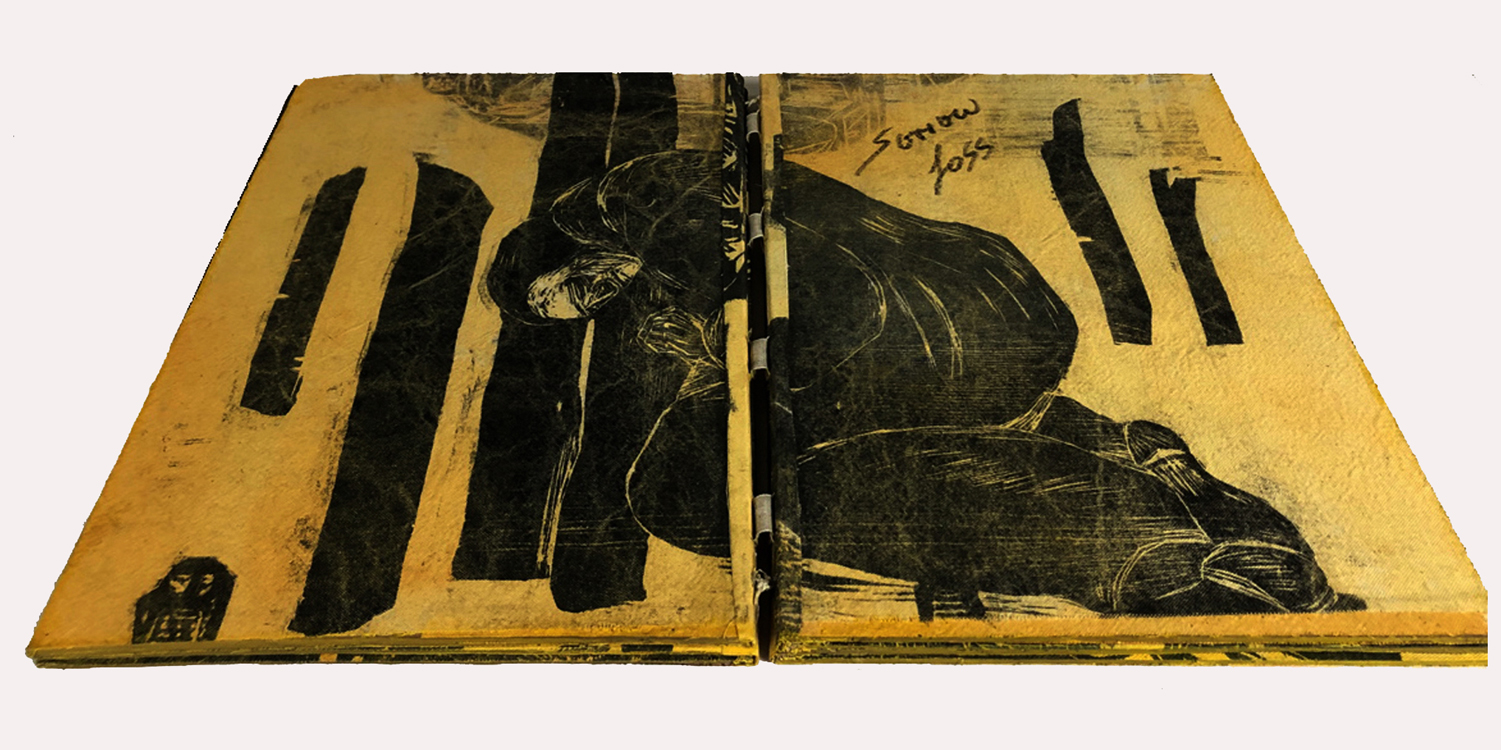
Loss, open
1 media/24 Loss_thumb.jpeg 2022-01-20T21:41:42+00:00 vclibrary 4b567aa9ea15046df7ed5f9e846949edf9240acb 4 4 plain 2022-01-20T22:09:34+00:00 Loss. Ilse Schreiber-Noll. Woodcuts on linen, mounted on board, 41 x 28 cm, 2021. vclibrary 4b567aa9ea15046df7ed5f9e846949edf9240acbThis page is referenced by:
-
1
2022-01-20T21:26:31+00:00
A Conversation with
Ilse Schreiber-Noll 8 plain 2022-01-20T21:48:16+00:00Angelina Papa: I want to talk to you first about why you frequently turn to Artist’s Books as your medium. Your artwork takes so many different forms, so why do you frequently go to Artist’s Books?
Ilse Schreiber-Noll: I studied printmaking and the art of the book at Purchase College. with the late Uruguayan - American visual artist Antonio Frasconi, who was one of our great woodcut artists. My concentration at that time was purely on printmaking with a minor in painting. My great love was bookmaking. I liked the feeling of putting pages together. At first, I mainly concentrated on limited edition books, often in collaboration with poets such as with the late poets Joseph Brodsky, Galway Kinnell, Dennis Brutus, Octavio Paz, John Cage and others who were still alive at that time. The agreement between the poets and me was that I would use one of their poems and in exchange I gave them some copies of the book. I did letterpress printing, like setting type and everything. These limited-edition books were more like the livres d’artistes that Picasso and other artists of his time used to make. They were enclosed in a clamshell box with loose, unbound pages. These unbound books would go to the buyer who then decided on what binding he or she would like to use. For myself, it was only a matter of visual preference to leave the pages loose in the box.
I did my master’s in fine art, also at Purchase College, in the late 80s. My MFA thesis was a book in collaboration with John Cage and Octavio Paz. In conjunction with the Art Against Apartheid movement, I completed a book with the South African poet Dennis Brutus to raise funds and another limited edition in collaboration with the late American poet Galway Kinnell, who passed away in 2014. We worked on several limited-edition books together. I got tired of doing woodcuts only, and of the flatness of the print, and over time went back to paintings in conjunction with painted, unique books usually accompanied by a series of woodcuts on the same subject matter. Since I loved the three mediums equally, I started to combine them. I felt that the book will add a dimension to a painting, which is missing in a painting: pages, which when turned add to a deeper understanding of its content. So, for me, a book is an almost necessary extension of a painting. I don’t know if that answers your question, that was a very long answer.
AP: I noticed that your art utilizes a lot of texture. The weight and size seem very intentional. Is that a factor in communicating your message? For example, in Thirsty Flowers, the pages are very heavy. Was that intentional to communicate the weight of the message?
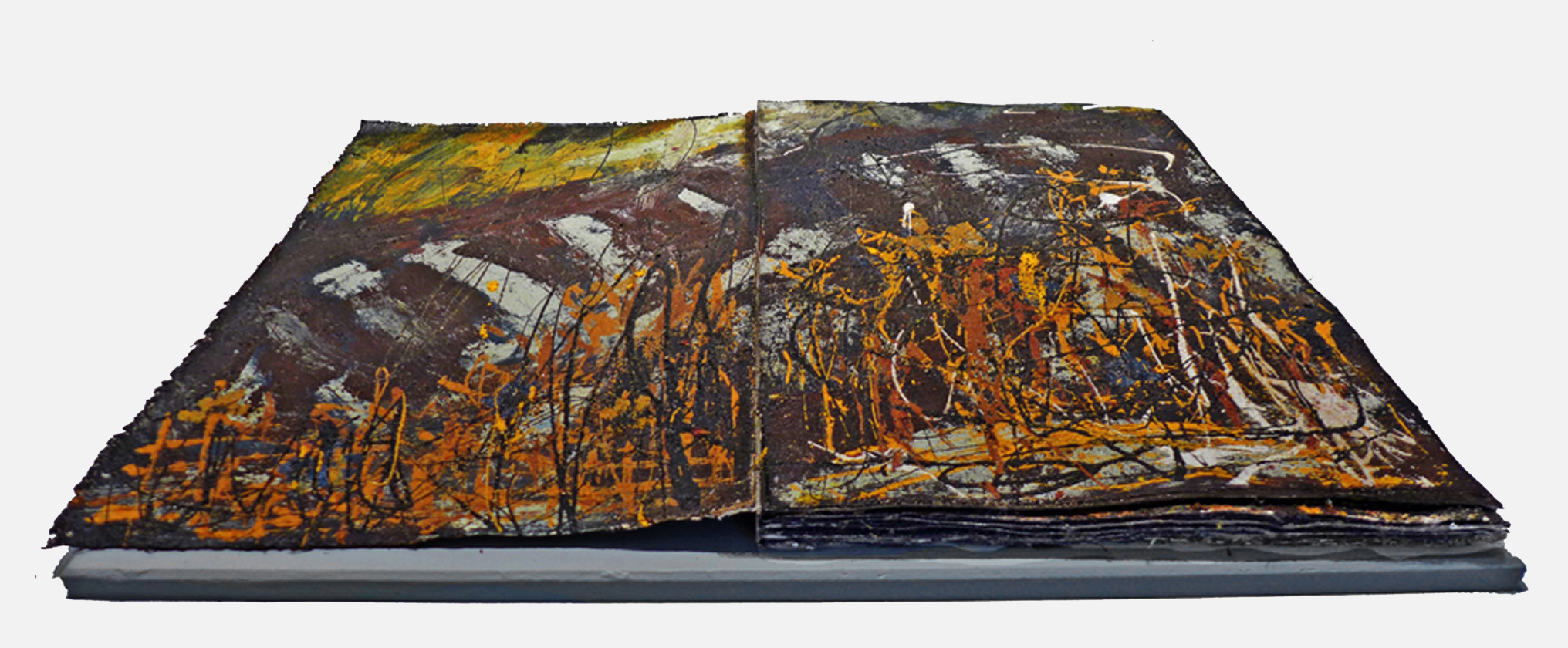
ISN: Yes, it was. I like very heavy surface texture. I’m probably influenced by the work of the German artist Amseln Kiefer who in my opinion is one of the greatest living German painters–I don’t know if you’ve ever heard his name. Heavy surfaces can transmit a more physical feeling. For example, if I were to make a book about war, the heavy, encrusted surfaces of the page will remind you of the lands and the once fertile soil under which lies history. When touching the page, one will be able to almost feel the pain of the people who once inhabited this land and image and get a sense of the destruction of the soil. I used to do a tremendous number of books and paintings against war. The soil is the blanket of the earth and is most important for us to be able to live. When we destroy it, we also kill all the little creatures present in it such as bacteria, fungi, algae, and others, and wide variety of larger soil fauna which keeps the soil fertile and alive. With this we do not only harm ourselves but the entire ecosystem. Trees will die and more. The beginning of a vicious cycle. By creating these tortured surfaces, I am hoping to bring the viewer closer to realize the outcome of our self-imposed destruction.
AP: I read that a lot of your influence, when you started making art, was from growing up in postwar Germany. With your work with apartheid, and in your current exhibits, it’s all very heavy and seems very political. Does your experience in Germany continue to influence you?
ISN: Yes, very much so. I saw the consequences of war and the destruction and heartbreak it caused to my country and to others. This experience will never leave me and always will be reflected in my work, but it also enables me to feel true empathy for countries at war today. My politically oriented work was also very strongly influenced by the work of my mentor, teacher, colleague and friend, Antonio Frasconi and the writings and plays and poems of the German playwright and poet Bertolt Brecht.
AP: A lot of your books are paired with poetry, or you incorporate fragments of poems physically into the books. When you use poetry, do you find poems that fit the art that you’ve already created, or is your art produced after you are inspired by a poem? Or is it kind of simultaneous?
ISN: Often, it’s simultaneous but equally often I just plan a book and if a poem pops up that fits the subject matter, I will integrate it into the book. Other times I pick a poem and use it as the main inspiration for the book. Here text and image are of equal importance. Did you see the Langston Hughes book that they have in the collection? Its title is Save the Dream/Save the Planet. This book was made in the last year of Trump’s presidency. I was not in favor of Mr. Trump, and this was my cry for change. The book was part of a series of large paintings and woodcuts with the underlying motto of Hughes’s poem, Let America be America Again, though the book was named differently. But I really loved this poem, and I wanted to use excerpts of it in my paintings and books. So that was planned. But many times, the poems come as an afterthought.
AP: A lot of your pieces for this exhibit, I noticed, have poetry by Walt Whitman. How has he been an inspiration to you and why was his work something you were drawn to for a lot of these nature pieces?
ISN: I just love his work and feel very drawn to him. His poems have tremendous depth and one can find one on every subject that moves us. His language is beautiful. Another reason, of course that I like to use Walt Whitman is that his work is in the public domain. Though it is secondary but becomes an issue when you make a limited edition. I used text from Hermann Hesse, a German poet, but had to pay for it. Whitman touches my heart. I’m sure there are a lot of new, wonderful poets. But I feel that Whitman’s poems say something that can apply to any time. That’s all I can say.
ISN: Timeless, yes.
AP: What drew you to creating pieces concerning the environment and environmental issues?
ISN: Well, I have been dealing with this subject since 2012. I live close to nature, I love the countryside, I love the fields, the trees and again I just love nature. I never liked to live in the city. The only city I could live in is Berlin, Germany, which feels like a park compared to New York City. The fact that we destroy nature is hard to understand, because we destroy ourselves at the same time. In 2012 I participated in the Hudson Valley Artist exhibition at the Samuel Dorsky Museum in New Paltz. Linda Weintraub was the curator. The title of the exhibition was, “Dear Mother Nature.” We were asked to present works that deal with the beauty or destruction of nature. Two years before in 2010 was the huge Deepwater Horizon oil spill, an industrial disaster in the Gulf of Mexico. I had made an artist’s book dealing with this tragedy. This was the Oil Spill book I followed by Oil Spill Book II and III. Number Three was in this exhibition. Its focus was on the oil tragedy of Nigeria. From then on, I got very involved with an environmental group founded by Linda Weintraub, who invited three artists for a solo exhibition in Pella, Iowa under the main title “Dear Mother Nature”. My subtitle was, “Nature Defiled.” I continued to create work: books, installations, prints, and paintings that dealt with the protection of our planet. I presently have a show in Beacon, also on this same subject. Really, I find it very important to show the beauty as well as the destruction in juxtaposition so the viewer is wondering and will ask the question: Why are we doing this to something so beautiful? Though I am often wondering will my work really speak to people? Will people learn to care or not? I don’t know. Yet if we do nothing, we all and future generation will be terribly affected. What do you think?
AP: I don’t know. I mean, what do you hope visitors of the exhibition will walk away with from your art?
ISN: I would like people to really see this juxtaposition. And with this think of what they could contribute to the preservation of the environment. If just one person walks away thinking, “Oh, what is she saying? What are we doing?” that would already be rewarding. I feel as if I am building a house very slowly brick by brick and can only finish it with the help of many. This example also applies to the preservation of nature. If many people work against its destruction, we can make an impact and together can bring about change. I’ve worked very much in the anti-apartheid movement for South Africa and participated in a lot of exhibitions. At that time, I also asked myself the same question, is it going to do anything? Or is it not? But artists from many countries, all over the world, people from all professions contributed and said: We must help to change this terrible system. And it became like a house we all built together. When the banks got involved, the apartheid system collapsed. I believe this couldn’t have happened without the help of many. My contribution was very small, but it added to help to bring the change. This is the same as working against the destruction of the environment or against wars. Sometimes we do it for selfish reasons because it makes us feel good, but it does not matter if we contribute to save our planet.
AP: In Loss, for example, there’s so much death, but there’s also recurring strands of hope. Do you have hope for the future?
ISN: We must have hope. If we don’t have hope then living becomes unbearable, right? I think people will learn. Though it will take a long time. But people will learn. Your generation is more aware of environmental issues than my generation ever was. So, I have hope, because it will, it will slowly get better. I hope. I really do hope.
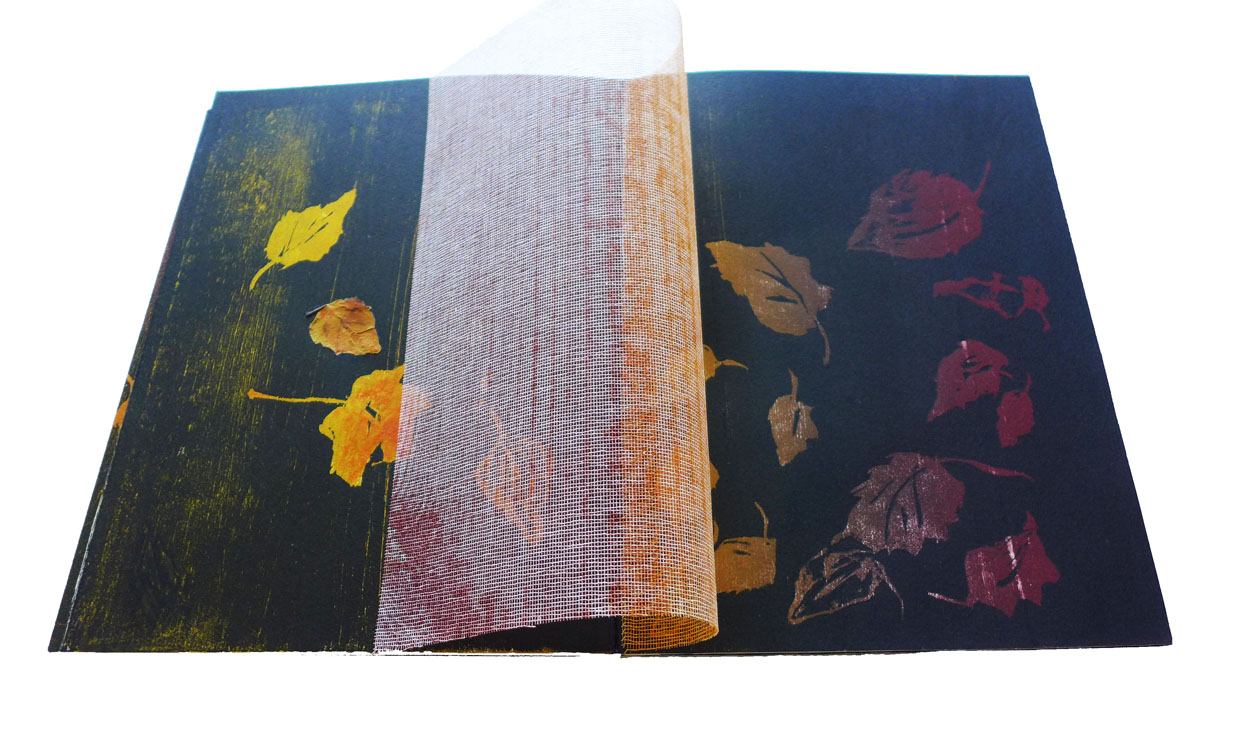
AP: At the same time, some of your pieces, like Autumn, are a celebration of nature but there’s also this looming sense of destruction—almost a foreshadowing. Is this intentional to create a skepticism of optimism while maintaining hope?
ISN: Not with Autumn, there was no intention. I thought it was very light. Maybe that’s just me. That’s always a problem with my work, it appears dark even when I think it’s lighthearted. No foreshadowing in that one. Autumn I produced in dedication to Antonio Frasconi. He died in 2013. I made this book for him. He was also a big admirer of Whitman. Maybe you’re not so wrong because there’s a certain sadness in it, since it was dedicated to his death. So maybe there is a little bit of foreshadowing also. Maybe you’re right. Yeah, I think you’re right.
But the Loss book, I mainly did in response to the happenings of the last two years. It’s dedicated to all the people who have suffered and the families who lost loved ones during the pandemic and to the people that where the victims of natural disasters in the last year, some caused by the effects of climate change. Often these disasters are manmade and not directly related to climate change. Many, many people died in Haiti. The last two years were tragic for all of us. For everyone. Young people could not attend school or colleges. Staying home locked in so to speak and loosing loved once in the pandemic has been very hard for everybody.
AP: Are you inspired by specific events? Like specific oil spills or specific natural disasters? Or are you more inspired by larger issues, like the broader climate crisis?
ISN: I’m more interested in the larger picture currently. But different specific occurrences contribute to the larger picture—that’s why I comment on them often individually. As I mentioned before I completed three books on the subject Oil Spills. The third book is dedicated to Nigeria. People got corrupted because the oil attracted companies and private businesses from everywhere to find oil in order to make money. Thereby they destroyed the land and took away the livelihood of the local fisherman, who depended on the proceeds of fishing to support their families. Fish could not live in the now-polluted water caused by the oil production. I have not been to Nigeria, so I can’t talk from personal experience. I read a lot about it. But I had a friend who lived there for a little while. And he said, the corruption among the people is unreal. And it all goes back to oil. The destruction oil has caused. So, that book is more dedicated specifically to Nigeria. The first oil spill book was dedicated to the oil spill in the Gulf of Mexico. And the second book is about the destruction of the marshlands and water by oil spills. So, when I do these books, there are connections to things which occur at the time, but all these occurrences are part of the big picture.
AP: When you make these two contrasting sides with the appreciation for beauty and nature, but also the destruction and the darkness, which one do you think is more important, in a sense, to create movement? Do you think people need to be more inspired by protecting beauty, or stopping destruction, or do you think they work together?
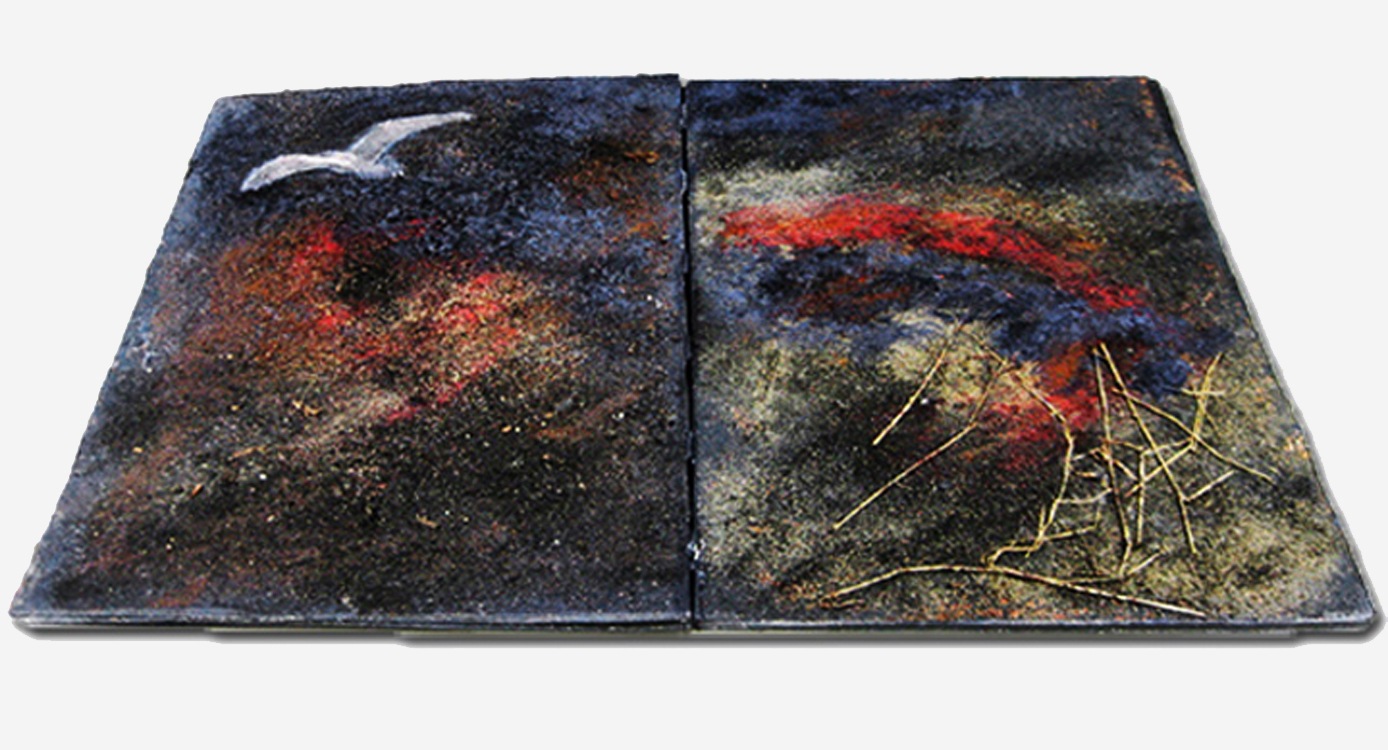
ISN: I believe they work together and are both of equal importance. In order to prevent the destruction of nature, we first must appreciate the beauty. Some people are attracted just by the beauty and deny that there is anything else and go through life without acknowledging the destruction, you know. I wish very much that the viewer who looks at my work will give equal attention to both sides and will reflect and ask questions such as: “What is it that we are doing to this beautiful land, what contributes to its destruction? How could this happen? What can I do to change this?”
AP: I agree that it needs both sides. There are such heavy and dark pieces and then to go back to the beautiful ones is a reminder of what we need to protect—and that’s really beautiful. The contrast is really powerful.
ISN: Yes, the contrast. That is good, that’s what I want you to feel.
AP: When you think about nature and your love for it, does it come from living around the Hudson Valley? Did your inspiration for nature come more from living in Germany?
ISN: I think it’s both. I was born in a small village in Germany, way out in the country. European villages are slightly different in architecture than those in this country. They are always located among fields, beautiful meadows with a little church at the center. I spent my school and college years partly in Germany. Therefore of course my work is deeply inspired from my memories of those years. It’s like with a language you know, it’s hard to lose an accent of a language you grew up with and went to school with and have spoken in your childhood. Yes, my upbringing in Germany certainly influenced my love for nature, but the Hudson Valley enforced and made me see it more consciously. So, I would say both to answer your question. I have lived for many years in the Hudson Valley, which is just one of the most beautiful places I can think of really. So, I would say both.
AP: Yeah, yeah, I definitely feel lucky to live here. It’s only my second Hudson Valley fall and it’s beautiful. Do you have any last thoughts that you’d like to share about this exhibit in particular?
ISN: Well, I honestly have to say I’m very, very happy about this exhibition. Because, you know, it’s very hard sometimes to show these large books, especially in such a beautiful, protected place and in such wonderful cases. I am delighted and especially excited to show in a college. I prefer to exhibit in colleges versus in galleries. My wish is that my work speaks to your generation. If that happens, I would be very pleased. Giving something to the next generation is a privilege. So, I’m very thrilled about this exhibition. And I’m really looking forward to it.
This interview has been edited and condensed.
Angelina Papa ’24