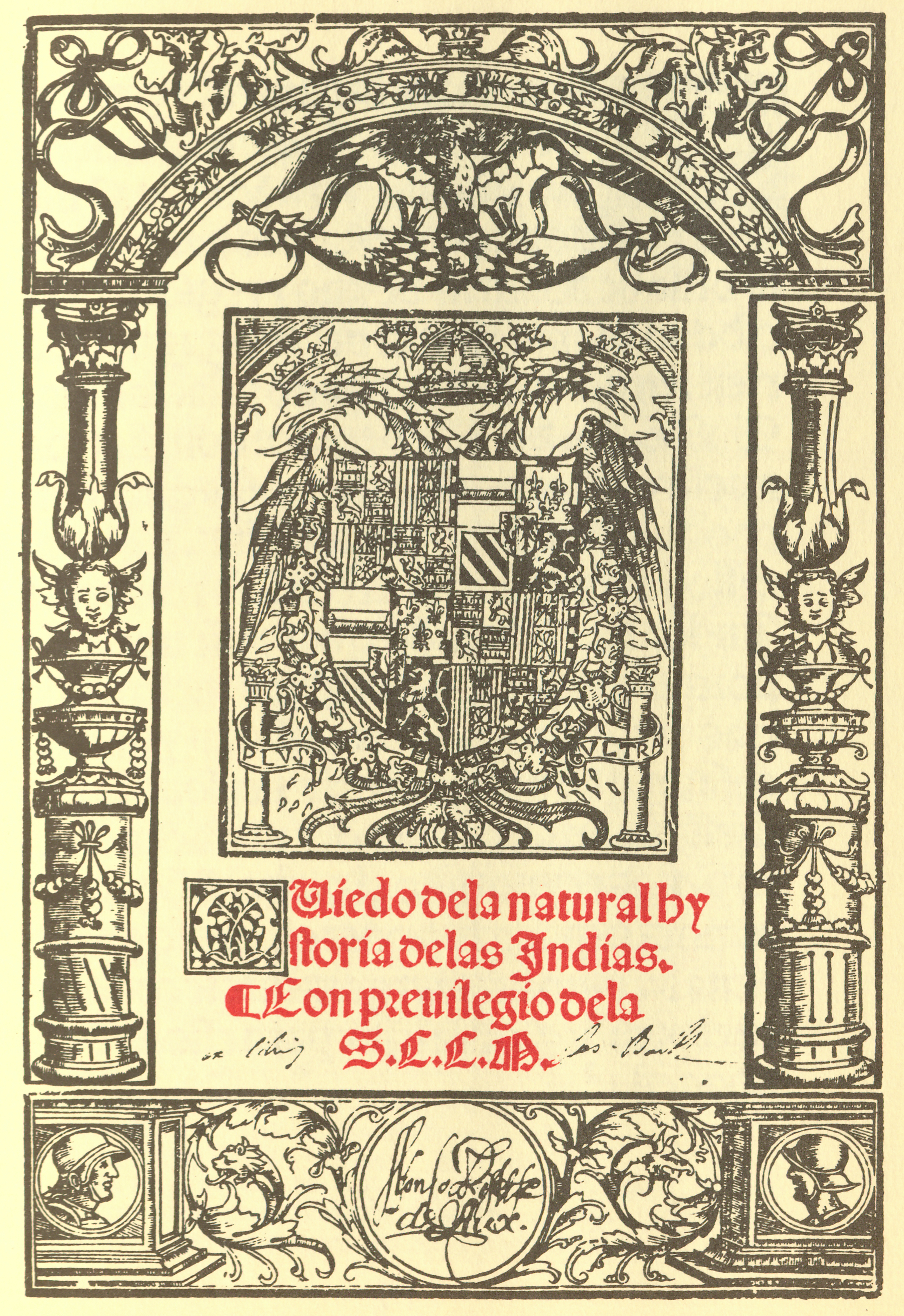
Gonzalo Fernandez de Oviedo y Valdés, De la natural hystoria de las Indias
1 media/2.Oviedo_ Fall_2022_Oviedo_Valdes_Titlepg_thumb.jpeg 2022-09-15T20:09:12+00:00 vclibrary 4b567aa9ea15046df7ed5f9e846949edf9240acb 5 1 plain 2022-09-15T20:09:12+00:00 1969 20220301 113023-0500 Facsimile of 1526 edition, in Gonzalo Fernandez de Oviedo y Valdés, De la natural hystoria de las Indias. Chapel Hill: University of North Carolina Press, 1969. vclibrary 4b567aa9ea15046df7ed5f9e846949edf9240acbThis page is referenced by:
-
1
media/botanicals_coverimage.png
2022-09-13T23:28:01+00:00
The Oviedo Project: A Translation of Gonzalo Fernández De Oviedo’s Historia General Y Natural De Las Indias by Michael Aronna and Lizabeth Paravisini-Gebert
7
Essay
plain
2022-09-22T16:09:57+00:00
The aim of the Oviedo Project at Vassar College— a collaborative digital humanities undertaking—is on the surface quite simple: We are seeking to produce the first complete translation into English of Gonzalo Fernández de Oviedo’s 16th-century Historia general y natural de las Indias, islas – y tierra firme del mar océano (General and Natural History of the Indies, Islands and Mainland of the Ocean Sea). Written between 1524 and 1557, the brief iterations of the text published in 1526, 1535, and 1547 were translated into English, Italian, French, German, and Latin; its fifteen editions in the 16th century marked the text as a classic of Renaissance ethnographic and natural history. The full text, however, was not transcribed and published in Spanish until 1851-1855 in a four-volume, nearly 3,000 - page edition sponsored by the Royal Academy of History. Our ongoing translation and edition is based on the Royal Academy’s text.
It is difficult to overestimate the importance of Fernández de Oviedo’s text to the study of the early history of the Caribbean and the conquest of Mexico and Latin America. In this sweeping four-volume work, Oviedo endeavored to construct a master narrative to document the different stages of the exploration and conquest of the Americas as well as to describe the natural world and the diverse indigenous civilizations and cultures of the newly discovered lands. In this sense the scope, creativity and innovation of Oviedo’s Historia general y natural de las Indias, islas y tierra––firme del mar océano could be described without exaggeration as one of the richest and most detailed primary sources on the history, cultures, biodiversity, and transformation of the Caribbean and Latin American regions during the first half century of European colonization. It was conceived, as Jesús Carrillo describes it, “as an ambitious editorial project that was intended to create a place in the European literary context for the immense ‘empty’ space at the western rim of the ocean.” In this way Oviedo’s text opens a rich trove of eyewitness accounts of the conquest and colonization, invaluable anthropological information and analysis, detailed descriptions of fauna and flora unknown to Europe, and a unique perspective on New-World warfare from a man familiar with the bloody contests for the religious and dynastic unification of the kingdoms of Spain in the courts of Ferdinand and Isabella. This explicit emphasis on autobiographical first-hand observation and experience in combination with other corroborated third-party witness accounts lies at the root of Oviedo’s openly and repeatedly stated objective of creating a new form of historiography which could address the natural and human history of the New World in critical dialogue with the established canon of classical Greco-Roman and medieval knowledge concerning the geography, morphology, and novelty of natural phenomena and human civilization along the peripheries of the known ancient world. In this sense Oviedo simultaneously lays claim to the unique scientific methodology, authority, and content of his Historia in opposition to ancient and contemporary historians, philosophers and cosmographers who based their findings on the reading and interpretation of established speculative texts. For example, while Oviedo worked in respectful dialogue with Pliny the Elder’s Naturalis Historia of the ancient Roman world, he also offered critique of the earlier work when Pliny’s commentaries were contradicted by Oviedo’s own empirical observations in the New World.
Yet Oviedo’s Historia has proven an elusive source for any scholars whose knowledge of the text is fragmentary due to the vagaries of its publication history. The brief Sumario published in 1526 at the request of Emperor Charles V was written in Toledo, Spain, reportedly from memory (Vázquez Quiroz 13). Significantly, the Sumario incorporated the first set of images, drawn by Oviedo himself, of new world fauna and flora, and is recognized as the earliest illustrated natural history of the new world. It was followed by the first edition of the Historia in 1535, which Oviedo revised for publication in 1547. Translated into numerous European languages following its initial publication, Oviedo’s Historia went through numerous editions in Spanish in the 16th century, marking the text as a unique contribution to the early history of the colonization process.
The burgeoning manuscript absorbed Oviedo’s complete attention, especially after he was appointed imperial chronicler in 1532 and began writing feverishly about every possible observable phenomenon in the newly discovered territories for the robust salary of thirty thousand maravedís a year. In Oviedo, Charles V had found the ideal chronicler, one seduced by his material, guided by an understanding of the task of the historian as that of conveying what he had witnessed first-hand or heard from multiple reliable witnesses, a Renaissance man eager to understand nature and human actions, motivated by scientific curiosity and an appreciation of his responsibility as a historian. This sense of responsibility was indelibly linked to Oviedo’s intended royal interlocutor and principal reader, the emperor Charles V. In his detailed account he provided his sovereign with a chronological and comprehensive understanding of all that had taken place and been discovered in the New World (Vásquez Quirós 16). Oviedo himself exalted this mission to serve the interests of Charles V by explicitly comparing his role and text to that of the Roman historian Pliny the Elder who wrote his Naturalis Historia for the Roman emperors Vespasian and Titus. One can summarize the high level of Oviedo’s achievement by recalling that the noted German naturalist and explorer Alexander von Humboldt “pays Oviedo the signal compliment of considering him the founder . . . of ‘what is called today physical geography’” (Gerbi 132).
An acute observer of all aspects of new––world phenomena—from minuscule chiggers to the richness of indigenous languages and cultural practices—the author prided himself on writing of what he and other first-hand informants had witnessed: from the pathos of the fall of Granada to the cruelty of the Spanish wars against a resistant indigenous Antillean population. His zest for understanding the new world of which he was the first official historian led him to engage everyone around him in eager conversations about the properties of plants, the nature of indigenous religious practices, the violent introduction of enslaved Africans in the Caribbean, accounts of important rebellions of indigenous peoples, the daring exploration and mapping of new frontiers, and the wonders of new foods and animals. As a detailed commentator of the natural world, we owe him the first descriptions of pineapples, hurricanes, and manatees; eager to understand the behavior of sloths, he lived with one as a pet. His narrative voice, colloquial, at times humorous, gossipy at others, and always engaging captures the vitality of his quest for knowledge and information.
Oviedo shared his wonderment for the New World with his reader whom he constantly addresses directly, explicitly calling their attention to the remarkable natural phenomena of the newly discovered lands and signaling the exemplary heroism, wickedness, ingenuity, and suffering of the Spanish and indigenous conquistadors and caciques whose triumphs and failures Oviedo recounts as factual history as well as tales of adventure, fate, and morality. In this way Oviedo created a fascinating narrative which sought to inform as well as to entertain. His marvelous narrative detailing the ecological and social history of the Indies engages the reader as empirical history and as fantastic literature much like other colonial non-fiction accounts of discovery, conquest and shipwreck by such renown and controversial explorers and conquistadors as Christopher Columbus, Hernán Cortes, and Alvar Núñez Cabeza de Vaca. These historical accounts mixed first-hand observation and lived experience with religious, philosophical and literary accounts of extraordinary worlds origin-ating in the texts of classical antiquity, the Holy Scriptures, medieval travel literature and 16––century novels of chivalry. In this sense it should come as no surprise that with Historia natural y general de las Indias Oviedo played a foundational role in the creation of the legendary and/or infamous aura surrounding these and other principal and polemical figures of the exploration and conquest of the New World in dialogue and debate with his contemporaries and rivals such as Bartolomé de las Casas and Francisco de Gómara.
As storyteller, Oviedo makes visible his desire to maintain the interest of his reader by explicitly drawing their attention to the implications of specific passages or events and through the structure of his chapters, which often begin and end with thematic observations on human nature, fate and virtue––providing a formal structure for each chapter as an autonomous story. Oviedo also signals the connections between chapters, frequently concluding them with suspenseful foreshadowing of related events and characters in future chapters––much like the author of epic poetry or serial literature. In this way the chapters function as specific accounts of natural phenomena, discovery and conquest introduced by the thematic preface or proem which anticipates the narration of the particular “history,” a term which in Spanish maintains the duality and tension between creating a factual account and creating a story in historical writing.
One should remember, nevertheless, that despite the fantastic quality of the lands and events Oviedo described, the continually reminds his reader of the veracity of his history and explicitly distances himself from the overly ornate and literary style of other court historians of his time. In this way, as Kathleen Myers has affirmed, Oviedo self-consciously defended his evidence-based methodology and unembellished Castilian prose, and more importantly, his accuracy, against the potential criticism of his humanist peers, responding to them in a wordy and lawyerly manner ). Thus, Oviedo’s writerly acumen as raconteur and his critical dialogue with classical and medieval historians does not diminish his ground––breaking approach to historical writing based on first––hand observation and experience. Or, in other words, as Álvaro Baraibar has indicated, Oviedo’s commitment to experience and his critical interpretation of the authority of his classical predecessors is precisely what distinguished Oviedo from his contemporaries.
Fatefully, Oviedo’s seminal contributions to early Latin American political, environmental, economic, and cultural history were substantially eclipsed by his death which occurred while he was editing his work for publication. The extensive manuscript, totaling in print above three-thousand pages, remained three-quarters unpublished when Oviedo died in 1557. Despite the recognition given to the Sumario and the mid––16th––century version of the Historia, texts frequently quoted and celebrated as key scholarly contributions, the great wealth of his insights and minutely detailed studies of all aspects of new––world history and phenomena remained unpublished until Spain’s Real Academia de la Historia commissioned the transcription, edition, and publication of the complete manuscript in 1851-1855. The four-volume edition opened new vistas into the world of the 16th century Caribbean for readers able to access the material in Spanish, but it did little to make this extensive new text available to readers in any other language. In fact, there is no translation of the four-volume work—a work that simply defies characterization––available in any language other than the original Spanish.
Moreover, Oviedo’s Historia, along with other accounts written by Spanish and Portuguese chroniclers of the period, have been reduced to obscurity by centuries of the concerted attempts of European rivals in the New World to demonize the Spanish Empire and to erase the Spanish origins of modern scientific inquiry in the Americas by such luminary naturalists as Francisco Hernández, José de Acosta, and José Celestino Mutis. This religious and racial vilification of Spain, known as the Black Legend, equated Spain with cultural and intellectual “backwardness” while ascribing the roots of modernity and scientific inquiry to the Protestant nations of the so-called “European” Enlightenment, a history from which Spain was excluded (Cañizares-Esguerra 24). This marginalization of the history of Spanish scientific investigation in the Americas from the 16th century up through end of the 19th century also contributed to the loss of status of the Spanish language as an instrument of empirical and theoretical analysis. This disciplinary disinterest in the Spanish language has no doubt contributed to the other practical reason for the inaccessibility of Oviedo’s seminal Historia, namely, the lack of an English translation. The need for such a comprehensive English translation has become particularly evident as the environmental humanities seek to reconstruct the ecological history of the first European Encounter with the New World—and can allow us to reconsider crucial aspects of the New World’s history, fauna, and flora from the perspective of this unique first-hand account.
This is where both the challenge and significant contribution of our translation project lie. We are undertaking the translation, already advanced, of the four––volume 19th-century edition of the text working in collaboration with a team of Vassar students in time for the celebration of the 5ooth anniversary of the publication of Oviedo’s Sumario in 2o26. The incorporation of a pedagogical component in our project responds to various pressures, realities, and opportunities of 21st-century academia. First, it is not feasible to expect one single scholar to dedicate a career to the translation and publication of a text as extensive as Oviedo’s Historia. In the face of this practical reality, the digital humanities in the form of an ongoing online translation of Oviedo’s Historia present new opportunities for collaboration, experiential learning, accessibility, and archiving of a comprehensive translation.
Therefore, in our translation, we have sought to reimagine and retool these practical, scholarly, and educational challenges as resources and opportunity. Accordingly, the Oviedo Project is a scholarly and pedagogical undertaking that endeavors to produce this much––needed comprehensive translation in the academic and institutional context and resources of a liberal arts college dedicated to innovative undergraduate education. In this light, the project engages Vassar students as readers and translators of Fernández de Oviedo’s text through workshops and frequent one-on-one tutorials led by Hispanic Studies faculty. The goal of this collaboration between students and faculty is to produce accurate, scholarly, fluid translations of chapters they themselves have selected. In this way students learn the fundamentals of translation theory and practice while working on a project of great importance in the history of the Caribbean and Latin America. The Oviedo Project stems from Vassar’s Intensive Experiential Work initiative (VIEW), envisioned as “innovative learning opportunities that will complement more traditional courses by extending beyond the classroom for a variety of faculty-mentored experiences requiring a high level of student agency and independence.” A pilot deployment of the Oviedo Project in the spring of 2o19 was received very enthusiastically by students and resulted in 42 translated chapters. The students have now passed the 5oo-chapters mark, in the process completing the translation of Volume One of the Historia during the spring 2o22 semester. Our aim is to enrich the translation with critical and interpretative annotations and other materials and create programing such as inviting scholars to campus to speak on Fernández de Oviedo’s work to complement the students’ engagement with the text.
While we understand the importance of the ultimate publication of the translation in book form, we are making the translations openly accessible through the project website as they are completed. The current website showcases the work done by students through the summer of 2o22 and is updated regularly as other chapters are completed. They represent an important contribution to our understanding of the New World from its first historian and should become accessible as soon as possible in order for these primary sources to be available to a scholarly and general public. Public engagement with the available translations has been lively, with the work already quoted in upcoming scholarly publication and providing vital materials for forthcoming documentaries on subjects as diverse as mining techniques in the early decades of the colonization process, the cattle industry in Florida, and some of the first known observations on climate change in the New World.
The challenges for the students are many. For most of them this represents their first––ever attempt at a translation. More importantly, the text at hand is a 19th––century edition of a Renaissance text written in an historical and learned Spanish language whose archaic syntax and verb forms are difficult to decipher for any contemporary reader. Moreover, Oviedo’s text abounds with unfamiliar scholarly references and arcane terms characteristic of a learned humanist thinker and writer of his time. This complexity can be attributed to Oviedo’s vast erudition and incomparable experience, an author who many recognize as one of the greatest prose writers of his time, and one whose many disciplinary voices and perspectives— courtier, historian, ethnographer, botanist, zoologist, and geographer, among others, and whose tone—playful, charming, stern, accusatory, defensive, angry, perplexed—offer numerous challenges to the novice translator. Nevertheless, our expectation is that the participating students produce their translation in one semester. We have, however, designed an effective course that emphasizes hands-on learning and whose result can be seen in the accuracy and quality of the more than 500 translated chapters now available through the project’s website, which include all chapters from Volume One, approximately two-thirds of the chapters from Volume Two, as well as a significant number of chapters from Volume Three of the Historia.
Our model for collaborative engagement of scholars and students in the production of a translation of this length and significance is one that we hope will serve as a model for similar projects aimed at the revitalizing of translation as an essential component of foreign language acquisition. Designed as a closely––mentored multi-leveled engagement with the text—as a form of apprenticeship in the endangered art of scholarly translation and interpretation—the project aims to bridge the gap between seemingly inaccessible “old” texts and evolving contemporary concepts of history, indigeneity, race and ethnicity, and natural and environmental history by tapping into the possibilities of scholarly mentorship opened by a liberal arts education. Conceived as a team effort through which they can contribute to making an important primary source available to a broad reading public, the project has been built on the students’ enthusiasm for a text they have come to understand through its relevance to contemporary questions about the impact of colonization on the environments of colonized and post-colonial societies, the evolution of racial categories and discrimination, the history of extractivist capitalism, or the textual intricacies of describing a new world in a language that requires reinvention.The project also builds on the timeliness of digital platforms as spaces where our students are comfortable working, as we move the Renaissance archive out of the library and into the digital space through which students move with greater ease.The project models new forms of scholarly work where the resources they need—to edit documents through synchronized platforms, to consult a variety of dictionaries and historical databases, to readily access maps, images of flora and fauna, heraldic coats of arms, and texts by Oviedo’s contemporaries to aid in translation, for example—are a couple of mouse clicks away. The students’ commitment to the project has been built in part through learning how to deploy these resources they see as “modern” to translate, and help others understand, a past that has been closed to many readers through the lack of a translation.
The idea of producing a translation of Oviedo’s massive Historia in collaboration with students stems from two related ideas: Vassar College’s history of teaching through original source materials, recognized by the exhortation to our students to “go to the source,” and the implementation in the 2o19-2o2o academic year of a new curriculum that incorporated “intensives”—pedagogical experiences envisioned as “innovative learning opportunities . . . requiring a high level of student agency and independence.”
Since English readers could not go to the treasure trove of information of the Historia as a “source,” we had an opportunity to engage in a challenging and ambitious project as an “intensive”: Could we not make the translation of the full Historia our collective challenge? Vassar students responded to this challenge with great enthusiasm, eagerly engaging in work on a challenging intellectual project that would open a new primary source to English readers for the first time in 5oo years, potentially impacting deeply our understanding (and scholarship about) the first fifty to sixty years of the colonization process in Latin America and the Caribbean and introducing us to species of plants and animals—some of them now extinct—that played a central role in the history- changing processes unleashed by colonization. Other striking examples of such colonial processes of lasting global impact are Oviedo’s riveting accounts of the Taíno rebellions of the early colonization of the Caribbean, such as the uprising led by the cacique known as Enriquillo or Enrique on the island of Hispaniola which presaged centuries of indigenous resistance and warfare against the Spanish empire. Of equal and related importance is Oviedo’s epochal report on the first known revolt of enslaved African people in the New World which also took place on the island of Hispaniola on the plantation owned by Diego Columbus, a friend of Oviedo’s, some two years after the beginning of Enriquillo’s uprising. In this account of the revolt of enslaved Africans, Oviedo expressed the Spanish fear of the potential linkage between the two rebellions as the demographic collapse of the indigenous population of the island made Spanish colonists ever more dependent on enslaved African labor in mining and agriculture.
The results since the inception of the pilot have been impressive, as can be seen through the translations posted on our website, representing the work of students between the spring 2o19 semester and the spring 2o22 semester, during which the translation of Volume One was completed. The students have become the most active recruiters of other students to the project, and we are happy to see that for students with knowledge and expertise in Spanish, participation in the project has become a rite of passage, an opportunity to leave an intellectual legacy through the completion of chapters that will stand as their signed contributions to a collaborative, uniquely “Vassar” project.
The responsibilities for the project are divided among a team of three collaborators, with Michael Aronna and Lizabeth Paravisini-Gebert as coordinators, instructors, and overall editors, and Nicolás Vivalda as instructor and associate editor. The editorial team has also included a rotation of Departmental Language Fellows, Ford Foundation Fellows and Vassar College Research Fellows. These student fellows have contributed greatly to the exceptional progress in the project. Perhaps the best way of explaining the tasks and responsibilities is to outline the ways in which we have been working on the project since the 2o18-2o19 academic year.
As indicated before, the project’s aim is to produce a complete professional, accurate, and fluid translation of Oviedo’s Historia general y natural in time for its publication as a book in 2o26. As translations are completed they are put through the editing process described below and then posted on our website so they become immediately accessible to readers. A digital version of the scholarly translation and edition of the text will be available through Scalar1 as an open––source book and archived following the best storage practices recommended by Vassar’s Digital Library. The print book is intended for libraries and scholars specializing in the early colonial period in Latin America.
During the first week of the semester, students enrolled on the project meet with their instructors (Aronna, Paravisini-Gebert, or Vivalda) to select the chapters they are interested in translating. The number of pages and complexity of the chapters is determined by their level of command of Spanish and whether they have enrolled at the 2oo or 3oo course level. We are now working on Volumes Two and Three of the four-volume 1851-1855 edition and students select their chapters from our database according to their interests or majors. [Participation in the project is not limited to students majoring in Hispanic Studies and we have incorporated a broad range of students from a broad spectrum of majors.] The database includes all chapter titles and students are encouraged to examine the chapters carefully for affinity and level of difficulty before making a final selection. Once a chapter is assigned to a student, it is noted on the database and the chapter is unavailable to others.
On the second week of classes, the team of editors meets with all the students enrolled to discuss the overall schedule for the semester (deadlines for various drafts, group meetings, individual meetings with their instructors), and to discuss translation theories and methodologies, with special attention to specific and practical strategies for beginning their work. These conversations—and related workshops throughout the semester—are meant to help students develop their translations skills and to address the complications of translating a 16th-century text (albeit transcribed into 19th-century Spanish) that contains vocabulary, expressions, and references often unfamiliar to undergraduate students. The work of translation often requires detailed research on topics like heraldry, 16th-century navigation, weaponry and battle tactics, botany and zoology (related at times to now-extinct species), the identification of species in modern taxonomies not available at the time, identification of references to works used or quoted by Oviedo as reference, as well as the mapping of places mentioned or visited in contemporary maps. We work closely with the students to develop the research skills and identify the best sources through which they can contextualize their target texts and produce a translation rooted in knowledge of the topic addressed in their chapters.
For the next four weeks, which lead to the deadline for the first draft, students are encouraged to work on their own with frequent consultation with their instructor, and/or the editorial team. The submission of the first draft is the occasion for lengthy one-on-one reviews of the trans- lation draft against the original, line by line, as needed, checking for accuracy in understanding the text, the teasing out of nuances and identification of difficult expressions, terms, and references, and the identification of areas of necessary research to determine the path to follow towards a second draft.
After the submission of the second draft of their chapters, the assigned member from the editorial team does an additional systematic check of the final draft against the original, checking for accuracy and flagging areas of potential review. In this way students undertake two supervised revisions of their complete draft. This is done for all translations and for all instructors. The editorial team also keeps a log of potential questions for further consideration regarding the translation of names of people and places, questions of consistency in terminology, etc. These are shared in editorial meetings for resolution and terms are added to a growing glossary that students use as a resource to assure consistent use of names and terms.
The new drafts go to the individual instructors to check again against the original and identify any concerns to discuss with the students before a grade is assigned. At this juncture the pedagogical component of student participation is completed with the end of the semester and the editorial team focuses on final revisions. Once the students have submitted their final drafts, both Prof. Paravisini-Gebert and Prof. Aronna individually perform a final review of all of the student translations. Subsequent to this revision, they meet to go over their revisions in detail with Prof. Vivalda, our Golden Age specialist, in a line-by-line manner. Once a draft is approved in this final joint review, the translations are “published” by uploading onto our website.
The process is time consuming, but it has to date produced excellent translations done by undergraduate students engaged in a learning process and an intellectual exploration of aspects of the work of the region’s first historian. Their work, we believe, is our strongest argument for the value of making this seminal text available in English for the first time in five centuries. What the students’ work showcases is something equally valuable—and that is the creativity and hard work invested by students who have seized the opportunity to make a salient contribution to scholarship through their investment in securing new skills for its accomplishment.
Michael AronnaAssociate
Professor and Chair of Hispanic Studies.Lizabeth Paravisini-Gebert
Professor of Hispanic Studies on the
Randolph Distinguished Professor Chair.
WORKS CITED:
Baraibar, Álvaro. “Las miradas de Gonzalo Fernández de Oviedo sobre la naturaleza del Nuevo Mundo.” Estudios Ibero-Americanos, vol. 4o, no. 1, 2o14.
Cañizares-Esguerra, Jorge. Nature, Empire, and Nation: Explorations of the History of Science in the Iberian World. Stanford: Stanford University Press, 2oo6.
Carrillo, Jesús. Naturaleza e imperio: La representación del mundo natural en La historia general y natural de las Indias de Gonzalo Fernández de Oviedo. Madrid: Fundación Carolina, 2oo4.
Fernández de Oviedo y Valdés, Gonzalo. Historia general y natural de las Indias, islas y tierra firme del mar océano. Ed. José Amador de los Ríos. Madrid: Imprenta de la Real Academia Española, 1851-1855.
Gerbi, Antonello. Nature in the New World: From Christopher Columbus to Gonzalo Fernández de Oviedo. Trans. Jeremy Moyle. Pittsburgh, Pa: University of Pittsburgh Press, 1985.
Myers, Kathleen, and Nina M. Scott. Fernández De Oviedo’s Chronicle of America: A New History for a New World. Austin: University of Texas Press, 2oo7.
Vásquez Quirós, Margarita. Historia y Ficción en el Sumario de la Natural Historia de las Indias de Gonzalo Fernández de Oviedo. Panamá: Academia Panameña de la Lengua, 2o2o.