What Can The Divine Comedy Teach Us About Late Medieval History? by Nancy Bisaha
In their quest to obtain a better understanding of the past, historians rely heavily on the unglamorous genre of non-fiction sources: legal documents, state records, treatises, and the like. This is the world we have been trained to trust as holding the best evidence. With painstaking analysis and the support of verifiable historical data, such sources enable us to reconstruct a moment in time with reasonable confidence. By comparison, literary works appear unsafe and misleading, yet historians find them hard to resist. Used with care, they can breathe life into the arid prose of sterile documents when their content intersects with actual events or phenomena. Where, then, does this leave The Divine Comedy? It is hard to imagine a tale less grounded in reality than Dante the pilgrim’s epic journey through the realms of the afterlife where he converses with mythical and historical personages from the distant and recent past. But historians have found much that rings true nestled between the lines of this epic fantasy. Dante the master poet was a keen social observer, a student of history, an experienced politician, and a devout member of the Catholic Church. As he picks his way among the souls of the damned, the saved, and the blessed, he paints an unforgettable portrait of human strivings, successes, and failures; strength and frailty; wisdom and arrogance; compassion and cruelty. Amid the landscape of heaven, hell, and purgatory, Dante offers countless insights about earthly society, particularly late medieval Italy.
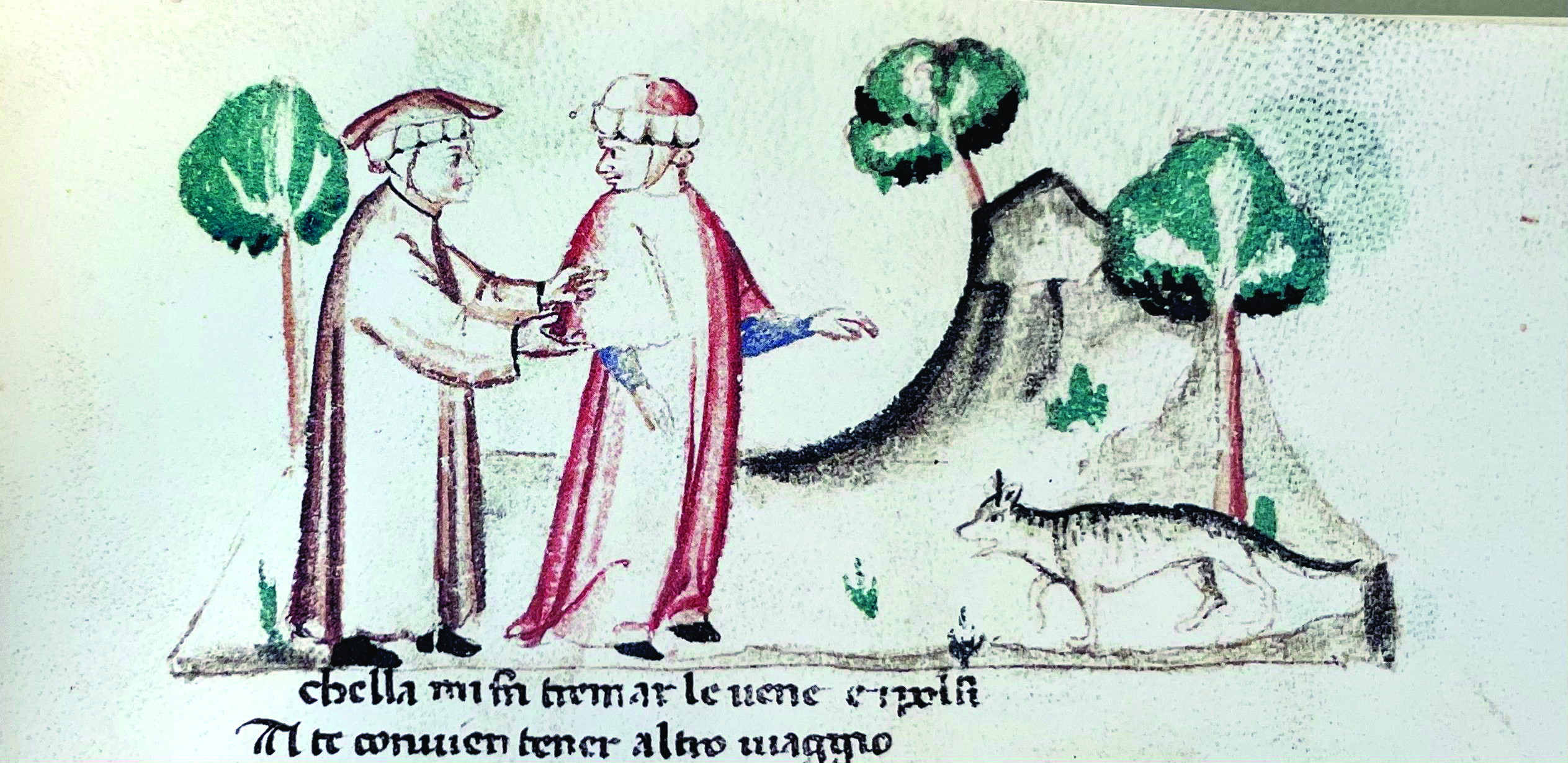
By combining the Divine Comedy with other contemporary sources, historians can gain insights into broader attitudes on a range of subjects, including the ancient past, marriage, politics, and religion. To be sure, Dante was more eloquent and vocal a critic than most of his contemporaries, but his concerns reveal a world in transition from some of the certainties of the Middle Ages toward the doubts and complications of Renaissance thought. For the remainder of this short essay, I would like to offer some observations, courtesy of my courses on Renaissance Italy and the High Middle Ages. Former students may recognize some of their own contributions. I am grateful to have worked through these challenging texts alongside them.
Dante is often described as having one foot in the Middle Ages and the other in the Renaissance. Nothing demonstrates this liminality better than his choice of guide in the Inferno: the Roman pagan poet, Virgil. Catholic doctrine at the time did not allow a place for the unbaptized in the higher realms, but according to Dante and other Christian thinkers, ancient “virtuous pagans” and a handful of distinguished Muslims like Saladin, Avicenna, and Averroes were worthy to inhabit the tranquil setting of Limbo. Virgil’s role as a moral instructor at every turn was not lost on Dante’s contemporaries who valued ancient Greek and Roman moral philosophy as guides to good living. These worthy predecessors were founts of wisdom for Christians seeking the pathway to heaven.
But first, Dante had to proceed deeper into the realm of sin, where he finds a great many contemporary Christians whose greatest error, it seems was ignorance of the precise meaning of God’s laws. One of the most poignant examples is that of Francesca and Paolo, whose encounter with the pilgrim early on his journey leaves him swooning with empathy (canto 5). The adulterous young couple, caught in the act and murdered by Francesca’s husband (who is also Paolo’s brother), are bound together for eternity, floating side by side in the winds of incontinence. The treatment of their story is masterful in its complexity: while Dante the pilgrim is swept away by their tragic story of longing and passion in an age of arranged marriages, including perhaps his own, Dante the poet embeds subtle cues about the lovers’ shallowness and deception. He reminds his readers that human sympathies and popular courtly romances do not alter the penalty for breaking God’s unchanging commandments.
Historians of Florence find intriguing material in Dante’s treatment of the republic he once faithfully served. For the most part, Dante uses the Divine Comedy to vent his frustrations about the city that exiled him and his party, the White Guelfs. One of the few upstanding Florentines to be found in the entire work is a romantic portrait in the Paradiso of his ancestor Cacciaguida—a sober and pious man, who lived within his means and died on crusade in 1147. His Florence, Dante claims, was smaller, peaceful, and modest, offering a nostalgic, imagined contrast to the excesses of his own day (canto 15). Many more Florentines feature prominently among the damned in the Inferno with the gluttons, the usurers, and others. But Dante’s dialogue with Farinata degli Uberti (d. 1264), a champion of the Ghibellines who supported imperial influence in Italy and stood for the rule of noble magnates over the more popular, democratic, and guild-based party of the Guelfs, is particularly evocative (canto 10). The pilgrim gleefully chastises the proud man who believed his noble blood-line entitled him and his party to rule the city, while also subtly commending Farinata for protecting the city from destruction when the Ghibellines were about to raze it. There was more than one way to be patriotic, Dante seems to suggest. By the end of his life, Dante was more of a Ghibelline himself, calling for imperial intervention in a divided Italy ruined by factionalism and papal domination. His wavering between support for republican government with all its messy inner workings and the perceived comfort and order of a monarchical or imperial ruler offer a window into larger political debates of the time.
Dante’s treatment of the Catholic clergy of his day is perhaps the most arresting of all his portraits. Men of the cloth are punished in droves for avarice, sodomy, fraud, and especially simony—the buying and selling of church offices. Who can forget his depiction of Pope Nicholas III (r. 1277-1280) punished among the Simonists in canto 19 of the Inferno by being stuffed down an inverted baptismal font with flames licking at his feet, calling out to the voices he hears above to ask if one of them was Pope Boniface VIII (r. 1294-1303), arrived for his eternal punishment years earlier than predicted. Boniface’s other sins are noted elsewhere in the Inferno, perhaps most poignantly in the person of a friar who committed treachery to help Boniface capture a city with assurances that the pope would forgive his transgression. But the friar finds that his confidence in the pope and lack of genuine repentance landed him in hell (canto 27). It is a harsh critique of Christians who trust in Catholic ritual without personal piety and self-examination, but it is a particularly strong indictment of the limits of the sacred powers of priests and popes. God is ever the ultimate judge, Dante affirms, overruling the clergy’s hopes and actions as He sees fit. But far from leaving his readers without hope, Dante paints a more comforting picture of the papacy in his Paradiso with St. Peter setting the standard for pious leadership grounded in humility and service, not power or greed. The first pope’s words, along with those of Saints Francis, Dominic, and others show Dante’s abiding belief in Catholic doctrine and his hope for renewal even as he despairs of its current leaders. The timing of this work is nearly two centuries before the Protestant Reformation, but it shows how visible the cracks in the Church’s spiritual authority had become to many.
A final point to ponder in the Divine Comedy is Dante’s broader message to fellow Christians about the way to avoid hell and, eventually, enter heaven. To paraphrase a wonderful lecture by Filippo Gianferrari, who taught in the Italian Department at Vassar (2017-18) and is now at the University of California, Santa Cruz, Dante’s reliance on the guidance of Virgil, his beloved Beatrice, and the lessons that saints and sinners teach him along the way—all this demonstrates his belief that no one gets to heaven on their own: it is necessary that humans help one another in a host of ways. The value that Dante places on community in the imperfect world we inhabit offers an inspiring lesson to readers of all beliefs. Dante urges reliance not only on God and the saints, but also on one’s family, friends, and neighbors. Even more interesting, perhaps, is the role that women play in this work: without the Virgin, St. Lucia, and especially Beatrice, who was moved by love in her abode in Paradise to help save Dante from his path of sin, he could never have conceived of his progress toward salvation. The depth of this spiritual quest and the impact it made on generations of readers suggests a moment in time when the blend of personal accountability, social support, and reliance on organized religion was entering a new phase.
On the seven-hundredth anniversary of Dante’s death, scholars can only imagine the historical insights the Divine Comedy will continue to spark for years to come. Each age finds new ways to connect to Dante and his work. A few decades after his death, he was heralded as paragon of romantic devotion for his worshipful, unconsummated love of Beatrice Portinari by Giovanni Boccaccio and a tragic victim of political intrigue; in 1436, Leonardo Bruni rejected that characterization, preferring to see Dante as a solid family man, a soldier, and a distinguished office-holder of the Florentine Republic. More recently, scholars have been arguing that the Divine Comedy was inspired, at least in part, by earlier Islamic stories about the Prophet’s Night Journey from Mecca to Jerusalem, during which he visited heaven guided by the Archangel Gabriel. Given the text’s translation into Latin in the thirteenth century and some of the similarities between the works, the possibility seems strong and merits further exploration. A better understanding of this question could soften some of the perceived barriers between different religions in Dante’s world view and place his inclusion of Muslim leaders and scholars in Limbo in an intriguing new light.
Nancy Bisaha
Professor of History