Some Rare Editions of Dante in Special Collections by Ronald Patkus
Given the long interest in Dante at Vassar, it’s no surprise that the Library holds many editions of the poet’s works. An author search of the online catalogue in fact brings up approximately 300 titles! Clearly Vassar students have always been able to access the Divine Comedy and other texts of Dante on campus, in Italian, English, and other languages. Of special note are editions deposited in the Archives & Special Collections Library. They comprise a substantial portion of the total number and represent some of the high points in publishing Dante over the centuries. There are significant examples from both the early modern and contemporary periods. The Fall Library exhibition draws on this collection, and focuses on the Divine Comedy. In this short essay I describe the books on display and touch on their significance. I hasten to say: many of them have colorful histories that expand our understanding of Vassar’s interest in Dante.
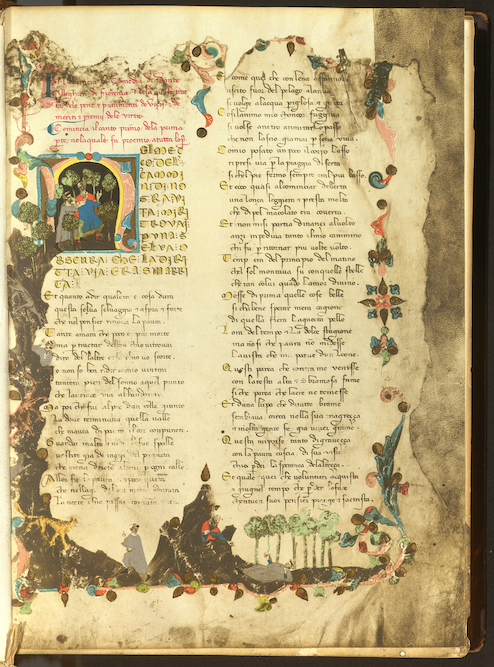
To begin, one should note that the Divine Comedy was frequently copied by hand during the 14th and 15th centuries.1 Vassar does not own any original manuscripts, but it does have several important facsimiles. Perhaps the best-known is a facsimile of the Codex Trivulziano. This manuscript was made in Florence around 1337 (Fig. 1). It represents an example of the “Danti del Cento” group of manuscripts that have been traced to the same scriptorium. Key features include a chancery-cursive script, a short summary (in red) at the beginning of each canto, text in two columns, and initial letters beginning each tercet. The miniatures have been attributed to the anonymous Master of the Dominican Effigies. The manuscript eventually came into the ownership of Prince Luigi Alberigo Trivulzio. The facsimile was published in 1921 in a limited edition of only 350 copies. Vassar’s copy has a leaf pasted in noting that the book was presented to the college “by the Italians of the United States of America on the initiative of Luigi Carnovale ... in commemoration of the six-hundredth anniversary of the death of Dante, September 14, 1921.”
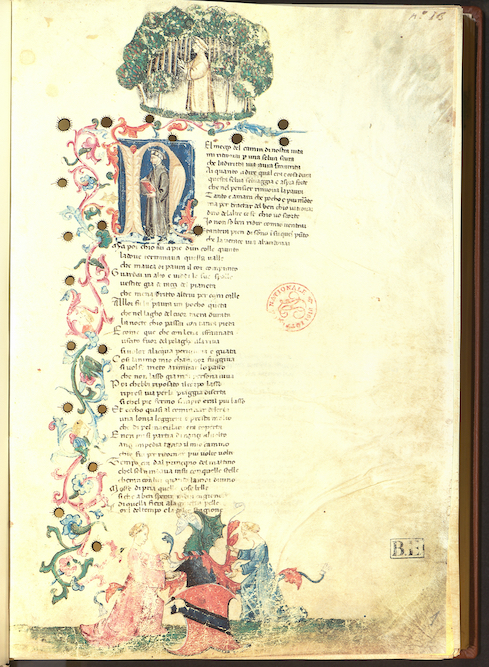
Another limited edition facsimile in the collection makes available a copy of the so-called Dante Estense, housed at the Biblioteca Estense in Modena, Italy (Fig. 2). The original dates from the end of the 14th century (likely between 1380 and 1390). The manuscript presents the full text of the Divine Comedy in a Gothic script written in one vertical column. In addition there are a number of illuminated and colored initials, and colored illustrations of various scenes in the upper margin. Before landing in Modena, the manuscript was for a time housed in France at the Bibliotheque Nationale, as indicated by the seal on the first page. The facsimile volume is accompanied by another volume of scholarly commentary. Vassar’s copy is one of many books acquired through the generosity of Carlo Zuccaro, in honor of his wife Bertha Bates Zuccaro, class of 1899.
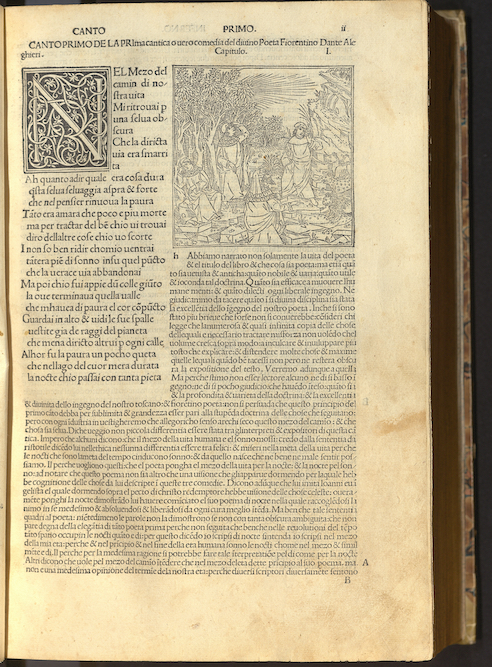
In the 15th century manuscripts of Dante were still produced, but from 1472 on works began to appear in print.2 Vassar is fortunate to possess two incunabula—books printed before 1501—with texts of Dante. Both were printed in Venice, which became a center of early printing. The first dates from 1484 and the second, on display, from 1491 (Fig. 3). On each page of this folio volume Dante’s text—appearing in a larger font—is surrounded by the commentary of Cristoforo Landino, a Renaissance humanist who championed vernacular works in Italian. In addition, the book includes 100 woodcuts, similar in design to the illustrations made by Botticelli for a 1481 edition published in Florence. Vassar’s copy includes handwritten annotations by a contemporary reader. It once belonged to Francis Fitz Randolph, a former trustee; the Library’s rare book reading room is named after him.
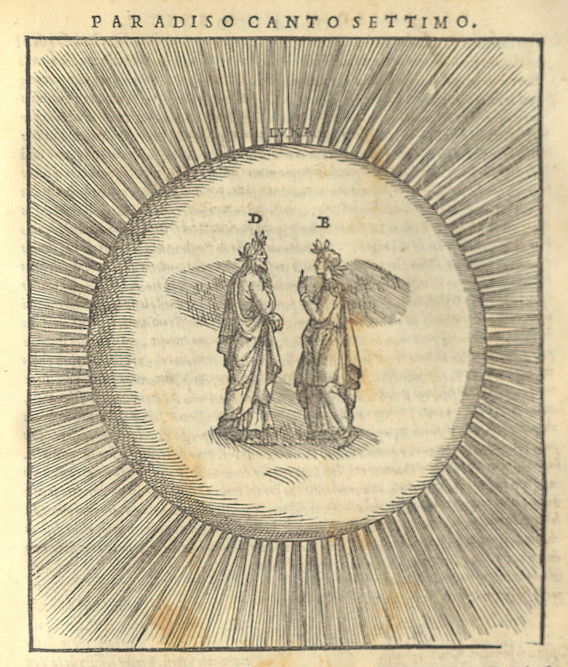
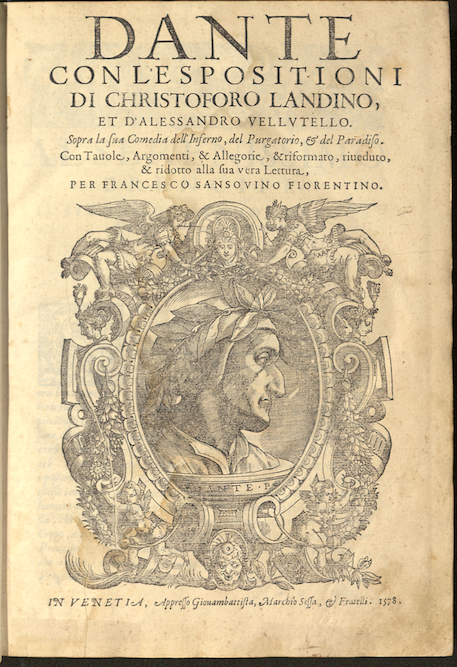
The Library holds two 16th century editions of Dante. The first, printed in 1544, features a commentary—again surrounding Dante’s text—by the poet and scholar Alessandro Vellutello. There are also 3 full-page and 84 smaller woodcuts; shown here is an image from Paradiso depicting Dante and Beatrice (Fig. 4). The illustrations are very faithful to Dante’s text, and some scholars believe Vellutello may have created the preparatory drawings for them. Vassar’s copy includes a note in Italian which describes this edition, written on the letterhead of the British Museum and pasted to the front endpaper. Some pages at the beginning are missing, but on those that follow are numerous contemporary annotations, jotted down in the margins. The book was a gift of Dorothy Meigs Eidlitz of the class of 1914, in honor of Professor Lucy Maynard Salmon of the History Department. The second 16th century edition of Dante at Vassar was published by members of the Sessa family, who were important to the book trade in Venice. They first issued the work of Dante in 1564, with the commentaries of both Landino and Vellutello. This 1578 edition has a different dedication but again includes both commentaries. The title page illustration of Dante is impressive (Fig. 5). The other woodcuts in the volume were reprinted from those of the 1544 edition put out by Francesco Marcolini (the previous entry in this catalogue). There are also additional texts by Francesco Sansovino, the Italian humanist who for many years lived in Venice and produced a guidebook to the city. Vassar’s copy of this book was acquired at auction in 2010.
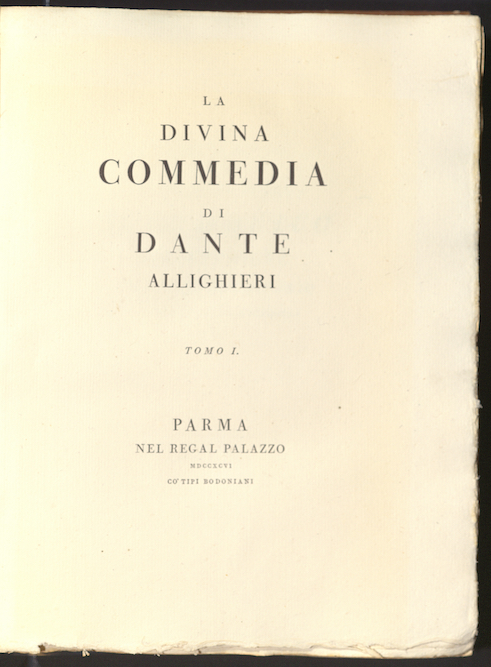
There were only 3 editions of Dante printed in the 17th century, and none after 1629. Interest in his work lagged during the Age of Reason, but new editions appeared in the 18th century. More than one was printed by the Italian type-designer and printer Giambattista Bodoni, known for his modern typefaces, which reveal strong contrasts between the thick and thin parts of individual letters. In order to focus on the typography, Bodoni’s books usually have wide margins and no illustrations; his editions of Dante are no exception. In 1795 he published the Divina Commedia in a limited run of only 130 copies. The next year, he reprinted the text in both a folio and quarto format. Vassar’s set, recently acquired through the Zuccaro Book Fund, is an example of the quarto edition (Fig. 6). There are three volumes, each roughly the same length. Of special note for the Vassar copy is that each volume is preserved in its original 18th century binding of orange-colored paper boards.
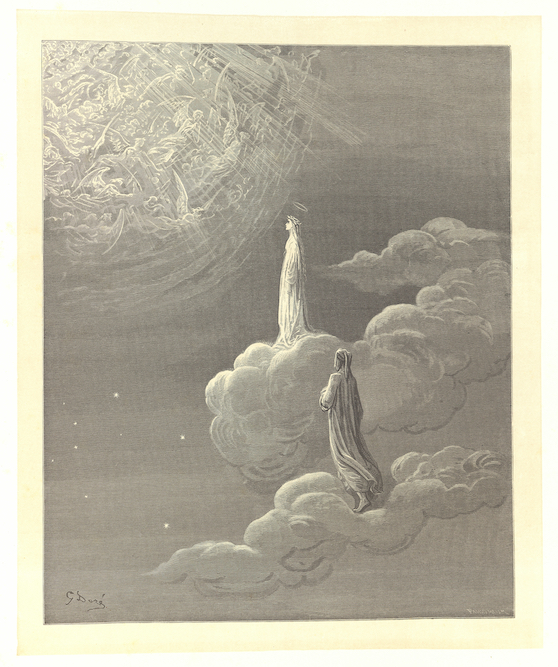
Many editions of Dante were printed during the 19th century. They ranged from simple reading sets in various languages to luxurious limited edition presentations. Of special note at this time were illustrations produced by the Frenchman Gustave Doré. Doré was one of the best-known artists of this period. During his lifetime he illustrated many important works, including all three books of the Divine Comedy, and since their appearance, they have had a great influence in western culture. Full-page engravings for Il Paradiso appeared in a limited edition published by Hachette in Paris (Fig. 7). Vassar’s copy is number 25 of 100. The donor of this book was Herbert Claiborne Pell, who had a career in politics, first as a United States Representative from New York, and later as Minister to Portugal, and then Hungary. From 1945 he lived at his home “Pellbridge” in nearby Hopewell Junction, New York. Pell donated a number of books to the Library and loaned items for exhibitions.
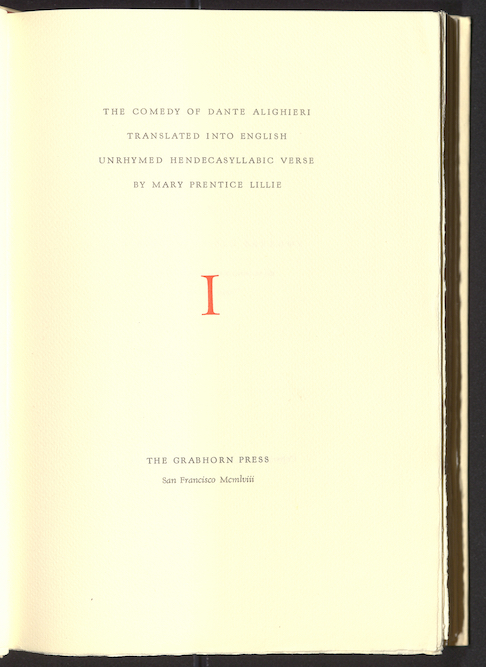
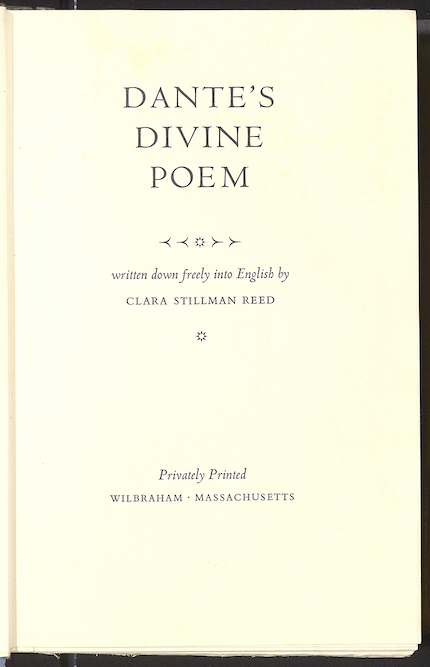
Interest in Dante continued during the 20th century, and the output of English translations was noticeably influenced by graduates of Vassar. We can first look to the work of Mary Prentice Lille, a member of the class of 1927. She traced her interest in Dante to a trip to Europe she took in 1922, a year after the 600th anniversary of Dante’s death. She began to learn Italian, and then continued her studies of the poet while in college and after graduation. By the early 1950s she decided to translate the entire Divine Comedy using hendecasyllabic verse. The text was printed in a beautiful limited edition set by San Francisco’s Grabhorn Press, one of the major fine presses operating in America at that time (Fig. 8).3 In the translator’s note of this three-volume work Lille states, “my chief aim has been to produce a readable translation, in a type of English verse that would suggest the Italian…” The typeface is a special casting of Kennerley Italic, made by the famous type designer and publisher Frederic Goudy, who for many years lived in the Hudson Valley. Another Vassar alumna who was greatly interested in Dante was Clara Stillman Reed, class of 1901. She maintained an interest in the poet well after graduation. Her work is based on a transcription of a translation she developed with her Dante instructor Jeannette Starr. Stillman Reed’s version appeared just a few years after Lillie’s, in 1962. It was privately printed by the Stinehour Press in Vermont (Fig. 9). In the acknowledgements she thanks especially two professors: Guido Ferrando of Vassar, and Valentine Giametti of Mount Holyoke College. Stillman Reed, who lived near Mount Holyoke, gave a number of books to Giametti. He later donated these and others to Mount Holyoke’s Archives & Special Collections, where they now make up the “Dante Collection.”4
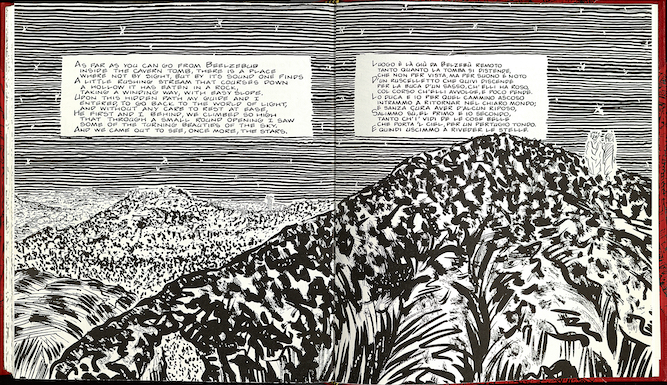
Of course during our present century people around the globe continue to pore over the poetry of Dante, and the 700th anniversary of his death has sparked renewed interest. As in the previous century, both reading copies and fine press editions still appear. One unique 21st century issue of Dante’s Inferno was published by the Thornwillow Press of Newburgh, New York.5 The website of the press states that “This edition is unlike any you’ve ever seen.” George Cochrane wrote out the entire text by hand and created all of the illustrations which fill the margins. His manuscript was then printed letterpress and hand-bound in several different versions (Fig. 10). Vassar has copies bound in paper, half-cloth, and half-leather. The half-leather is shown here; it is one of only 66 copies, printed on eggshell paper and bound in scarlet half-morocco and paste paper boards. Vassar is the official repository of all publications put out by Thornwillow.
This essay has focused on ten books of the Divine Comedy that reside in Special Collections, just a small portion of those currently among the holdings. If space allowed, many more could have been included. In any case, while I trust readers will enjoy learning about these titles, I hope they will also be inspired to inquire about others, and even to look beyond our collection for other examples. The universe of books relating to Dante is wide and diverse, and awaits your further explorations.
Ronald Patkus
Head of Special Collections and Adjunct Associate Professor
of History on the Frederick Weyerhaeuser Chair
NOTES
1 A listing of manuscripts is available online at
https://www.danteonline.it/english/codici_indice.htm
2 See the website “Renaissance Dante in Print, 1472-1629,”
at https://www3.nd.edu/~italnet/Dante/
3 For more on the works of the press at this time, see Bibliography of the Grabhorn press, 1957-1966 & Grabhorn/Hoyem, 1966-1973 / edited by Robert D. Harlan. San Francisco: John Howell/Books, 1977.
5 For a history of the press up to 2010, see Ronald D. Patkus, Ars Omnia Tuetur: 25 Years of Fine Printing at the Thornwillow Press. Newburgh, NY: Thornwillow Press, 2010.
This page references:
- Il Codice Trivulziano 1080 Della Divina Commedia
- Dante Estense: Cod. α.R.4.8 (Ital. 474): Biblioteca Estense Di Modena
- Comento Di Christophoro Landino Fiorentino Sopra La Comedia Di Danthe Alighieri Poeta Fiorentino
- La comedia di Dante Aligieri / con la nova espositione di Alessandro Vellvtello
- Dante con l’espositioni di Christoforo Landino et d’Alessandro Vellvtello sopra la sua comedia dell’ Inferno, del Purgatorio, & del Paradiso
- The divine comedy: Inferno
- Il Paradiso Di Dante Alighieri / colle Figure Di G. Doré
- The Comedy Of Dante Alighieri
- La divina commedia
- Dante’s Divine Poem