The Photo-Sculptures of Domenico Mastroianni: Dante’s Divina Commedia by Emma Iadanza
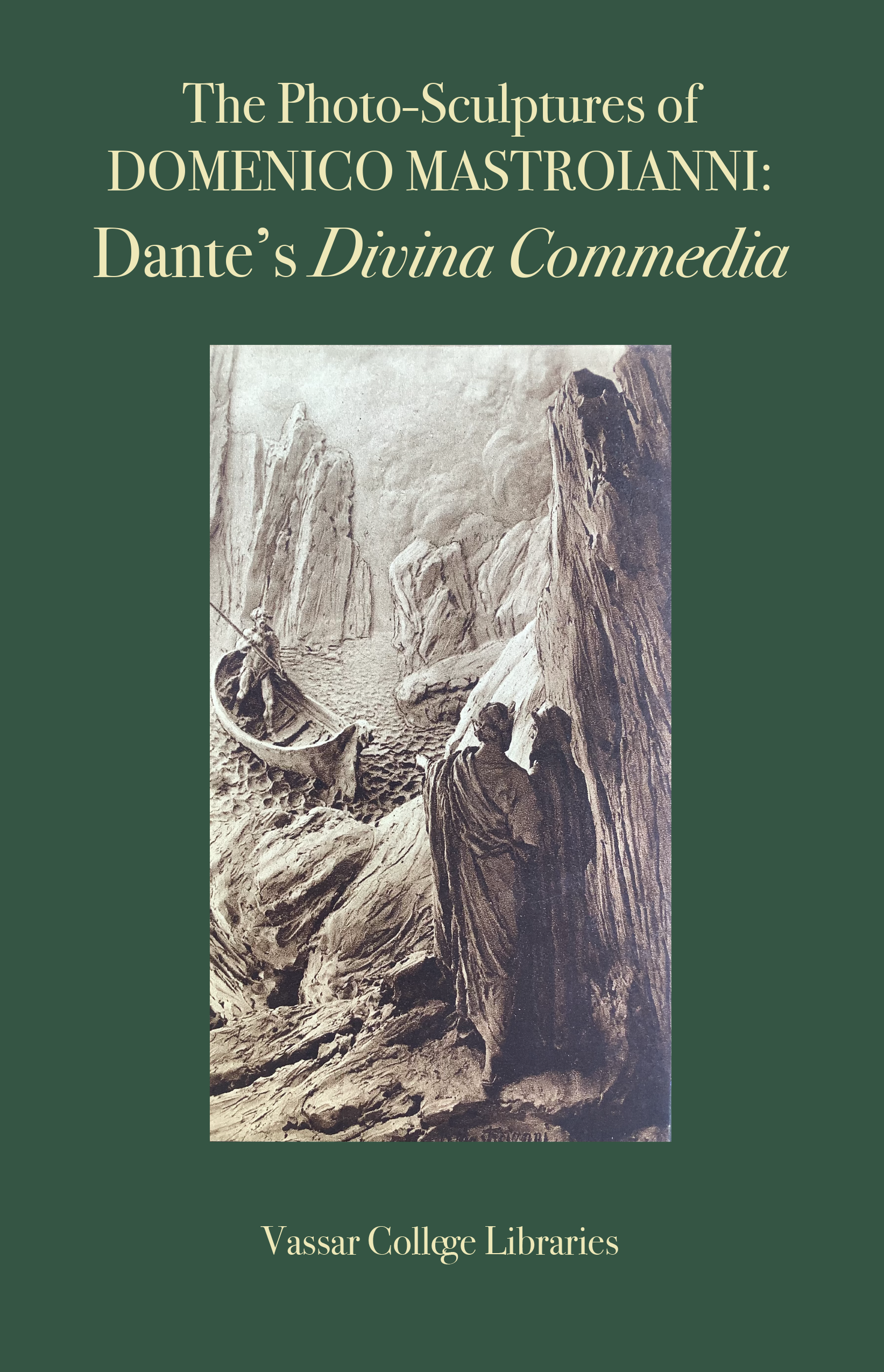
In the seven hundred years since his death, Dante’s Divina Commedia has inspired a number of artistic interpretations. Among them is the series of photo-sculpture postcards by Domenico Mastroianni (1876-1962), an Italian artist who worked in the Art Nouveau style. Mastroianni was a master of sculpture éphémère (ephemeral sculpture) he would create scenes on clay plates and photograph them. Easily reproducible, these photographs were then printed as postcards, which were cheap collectible items available to the public. Mastroianni produced such sets after other works of literature, such as Manzoni’s I Promessi Sposi, historical scenes, and even as political propaganda in favor of Italy’s fascist regime in the 1930s and 40s.
This collection of postcards belonged to Bruno Rosselli (1887 – 1970), a professor at Vassar from 1919 to 1932, responsible for creating an independent Italian Department in 1922. In his early days at Vassar, Rosselli was popular among the students, a number of whom he took to Italy in 1921 to celebrate the 600th anniversary of Dante’s death. He ultimately left Vassar in 1932 after a tilt with President MacCracken, presumably leaving the postcards here. Nevertheless, Rosselli’s work in Poughkeepsie had a lasting impact on the study of Italian at Vassar, and even gained him the recognition of King Victor Emmanuel III and his chancellor, Benito Mussolini.
Vassar’s set of postcards is incomplete, including only 17 of the 52 that Mastroianni created. As reflected in our collection, the majority of scenes (nine of the original twenty-six) are from Inferno. There are fewer from Purgatorio (seven of the original sixteen), and even fewer from Paradiso (one of ten). No publication date is given on the cards, although it is possible that Rosselli acquired them during his trip to Italy in 1921, which may connect them to the 600th anniversary of Dante’s death.
Each black-and-white photo-sculpture represents a scene from Dante’s Commedia and is paired with a set of lines from the poem. The compositions often evoke Gustave Doré’s famous prints after Dante, but are individual in their use of the photo-sculpture technique. Mastroianni’s skill with clay allows for a wide range of textures, while the lighting of the photographs creates dramatic shadow effects, especially in the scenes from Inferno. Vassar’s collection of these cards provides a fine example of Mastroianni’s work, as well as a connection to the history of the Italian Department and the study of Dante at Vassar.
– Emma Iadanza ‘22
Works Consulted:
Brady, Patrick. “Bruno Rosselli.” Vassar Encyclopedia. 2013.
Digital Dante. New York, NY: Columbia University Libraries, 2018. https://digitaldante.columbia.edu/
Tebaldi, Augusto. “Cartoline Dantesche - La Divina Commedia [Serie Domenico Mastroianni]”. Antro di Ulisse. 12 July 2020. https://bookstore.antrodiulisse.eu/Sussurri/cartoline-dantesche-la-divina-commedia-serie-domenico-mastroianni/
“The Ephemeral Sculpture of Domenico Mastroianni.” Images Musicales stories. 12 February 2017. https://blog.imagesmusicales.be/the-ephemeral-sculptures-of-domenico-mastroianni/