Emma Iadanza
1 media/b04a11e2-11a9-4aa5-8741-22cf3f559014_thumb.jpg 2021-08-23T19:23:11+00:00 vclibrary 4b567aa9ea15046df7ed5f9e846949edf9240acb 3 1 plain 2021-08-23T19:23:11+00:00 44.061230555556,11.572827777778 vclibrary 4b567aa9ea15046df7ed5f9e846949edf9240acbThis page is referenced by:
-
1
2021-08-23T19:20:16+00:00
Il Treno di Dante: A Pilgrimage to Ravenna by Emma Iadanza
4
Student Essay
plain
2021-08-23T19:36:05+00:00
This summer, I had the opportunity to spend two months in Florence, interning with the Medici Archive Project and researching for my thesis at the Archivio di Stato. While my academic focus tends towards the 15th century, Dante has long had a special place in my heart. I read Inferno for the first time in 7th grade and have carried bits of the Commedia with me since then. Thus, given my base in Florence and this year being the seven hundredth anniversary of il Sommo Poeta’s death, I made it a point to do something Dante-themed. The perfect opportunity presented itself in “Il Treno di Dante” – a day trip from Florence to Ravenna aboard a vintage train, following the path that the poet took to the city where he died. When I heard about it, I knew I had to go: the combination of medieval poetry and an antique train were too much to pass up, not to mention the appeal of a day trip to Ravenna. I had been to the “City of Mosaics” seven years ago, but we only had time to pay our respects to il Sommo Poeta; there had been no time to properly explore the city that he called home at the end of his life.
Those middle weeks of the summer were hot and exhausting, and the thought of getting out of Florence put me more in the mindset of Boccaccio than of Dante. An escape from the city was just what I needed: my mind had become fogged by the complicated bureaucracy of the archives, the heat, and the growing swarms of northern European tourists who had begun to descend upon Florence. I was a little reluctant to leave, what with so much work to do and only a few weeks left – but my roommate convinced me to go, and I’m very glad for it.
The train left at 8:50 AM from Santa Maria Novella, Florence’s main station. Rising early, the two of us dressed (in a vintage mindset, of course) and took a brisker-than-usual walk from our apartment to the station. Walking past the cathedral and Dante’s “bel San Giovanni,” I found myself reflecting on the scope of our trip. When Dante left Florence for Rome in 1301, coming back was a given, just as it was for us. With his exile, however, returning was a privilege he was denied. How lucky were we, able to choose to leave Florence? Ravenna was a day trip, not a life sentence; getting out of the city was a breath of fresh air, rather than a punishment. It made me feel almost voyeuristic – but, thinking on his character, wouldn’t he be pleased to know that people come from across the world to follow in his steps? He would be happy for, if not a little jealous of, our return.
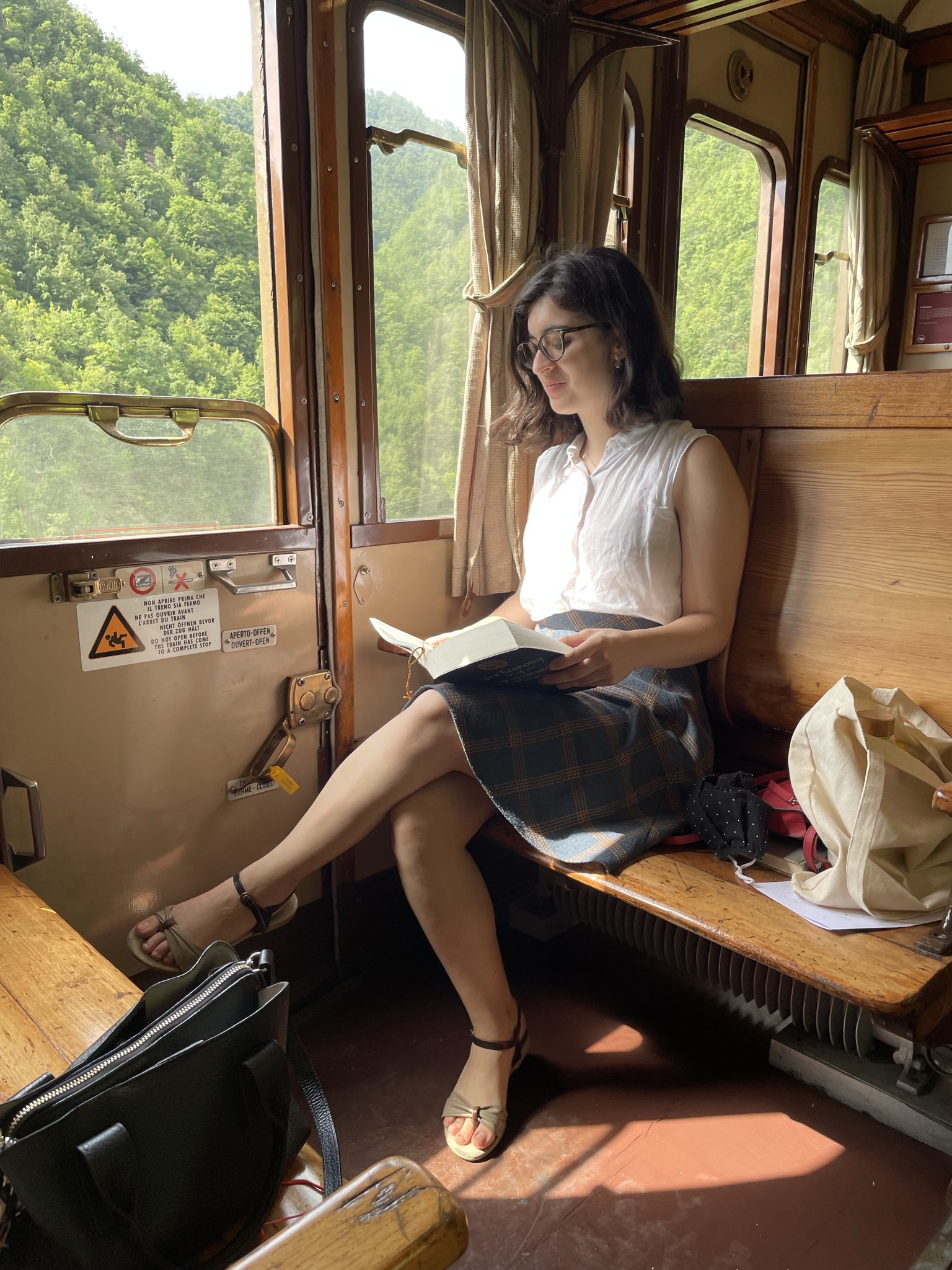
After our ritual of cappuccino and cornetto was complete, we found our way to our track. The eponymous “Treno di Dante” sat in all its glory among the other local trains, whose aesthetic appeal paled in comparison. The three second-class cars from the “Cento Porte” – a commuter train from the 20s – felt like something out of an Agatha Christie novel. The connection between the Jazz Age and Dante was a little lost on me – “medieval” and “vintage” clash a little – but I didn’t mind. It was pure joy to climb aboard and stick my head out the windows, looking out at the station as if about to go on the Grand Tour.
In typical Italian fashion, we set off just behind schedule. It would take three hours to traverse the Apennines, following a scenic route and stopping in small towns throughout Tuscany and Romagna: Borgo San Lorenzo, Marradi, Brisighella, Faenza, and Ravenna. The idea was that one could get off at any stop and explore the “terre di Dante,” but when we got aboard, we found that the majority of people were headed for Ravenna.
The pace was slow and steady, but the ride went much quicker than expected. The views were stunning and diverse, from the steep slopes of the Apennines to the flat fields of Romagna. The train’s wooden seats were unexpectedly comfortable, and the fresh breeze from the open windows was fortifying. I also came to understand why women would wear “traveling clothes” back in the day: passing through tunnels we were pummeled with dirt, and when we stepped off the train in Borgo San Lorenzo for a coffee break, my white shirt and the pages of the book I had brought with me were streaked with dark soot.
Arriving in Ravenna just past noon, we had a tasty lunch – delicious Romagnol pastas, featuring bread with salt, which Tuscany famously lacks! We certainly thought it was a treat, but wondered, would Dante have sought out the flavorless bread of his homeland?
But truthfully, Ravenna has an incredibly different character than Florence. Both times I’ve visited, it felt oddly deserted, like a beach town in the off-season. The buildings are relatively new, cheerful and brightly colored, and the cobblestones fresh and smoother than those in Florence. The restaurants and museums felt sleepy, even the ones that attracted the most attention – the mosaics and, of course, Dante.
His tomb, although hard to miss, feels tucked away. It’s intimate, even though it’s set at the end of a long promenade. Perhaps it’s simply a symptom of Ravenna’s character: there’s a strange combination of calm and unease in the air. Approaching the tomb, one knows this place is sacred. I felt the same way the first time I had visited. Although the elegant mausoleum is situated on the street, people grow quiet and bow their heads to pay their respects. Is it the building that makes his presence known, or is it that aura of fame? Would it be the same if he was buried in Florence? Dante is one of the few things Ravenna has to its name and they hold onto him tightly, repeatedly refusing to return him to his hometown.
As a student of history, visiting the physical places where momentous (and less momentous, or even mundane) events occurred has always been important to me. Feeling the nature of a city or site often charges my understanding with a new depth. Visiting tombs, however, is even more personal – and, in this case, one who has affected me personally, even though he lived so long ago. Having spent so much time studying Italian and the early Renaissance, Dante this year felt incredibly appropriate. I’m so glad to have been able to take this trip, to visit Ravenna as a (informal) representative of Vassar, and to pay tribute to il Sommo Poeta.
In Paradiso, Dante wrote of his hope for redemption through the immortality of his writing, and to “[tornare] poeta, e in sul fonte / del mio battesmo prenderò ’l cappello” – to “return as a poet, and at the font / of my baptism receive the laurel crown” (25.8-9). Although he never made it back, I did – and walking home that night, I again reflected on my luck. Having studied the city and its history for so long – and now having lived there for two months – Florence feels like home. Surely the deep sorrow and longing I felt at leaving is not so dissimilar from Dante’s. I wouldn’t go so far as to call my return to the United States an “exile,” but I feel the heartache of an unwilling departure. But then again, unlike Dante, I know I’ll return to see the city and celebrate the poet whose names ring among the stars.
Emma Iadanza
Vassar '22