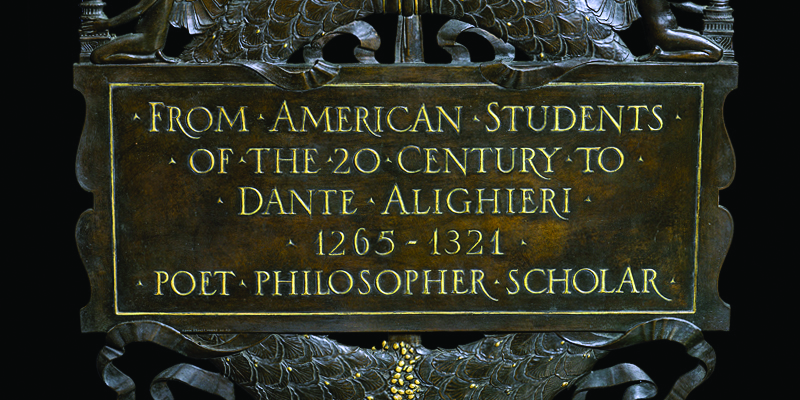
Image of plaque at Museo Dantesco in Ravenna, Italy.
1 media/Essay Frontispiece_thumb.jpg 2021-08-10T13:04:42+00:00 vclibrary 4b567aa9ea15046df7ed5f9e846949edf9240acb 3 1 “From American Students of the 20th century to Dante Alighieri – 1265-1321 – Poet, Philosopher, Scholar.” The photograph of a bronze plaque with this inscription features prominently on a special website created by the city of Ravenna, Italy, for the 700th anniversary of Dante’s death. The plaque, currently on display at the Dante Museum in Ravenna, was donated to the city where the poet is buried by Vassar students one hundred years ago. plain 2021-08-10T13:04:42+00:00 vclibrary 4b567aa9ea15046df7ed5f9e846949edf9240acbThis page is referenced by:
-
1
2021-08-10T12:55:37+00:00
A Dante Pilgrimage by Simona Bondavalli
7
Essay
plain
2021-08-10T20:03:25+00:00
"From American Students of the 20th century to Dante Alighieri – 1265-1321 – Poet, Philosopher, Scholar." The photograph of a bronze plaque with this inscription features prominently on a special website created by the city of Ravenna, Italy, for the 700th anniversary of Dante’s death. The plaque, currently on display at the Dante Museum in Ravenna, was donated to the city where the poet is buried by Vassar students one hundred years ago. In 1921, Vassar College commemorated the sixth centennial of Dante’s death with an extraordinary trip to Italy: a nine-week journey, four of which were spent touring the Italian peninsula and sightseeing cities that were significant to Dante’s life. The trip culminated with a visit to the poet’s tomb, where the students delivered their special gift. The mayor himself received the group at the train station, and a marching band escorted them to his palace for a reception. “Then the official ceremony at Dante’s tomb took place. The American flag unveiling the tablet was removed, while the Italian women showed their appreciation by presenting the group with flowers.”1 This brief account of the momentous occasion, published in the Miscellany News in September 1921, summarizes several enthusiastic reports published during that summer by major Italian newspapers.
One hundred and seventy people participated in the promptly-named “Dante Pilgrimage.” All were American college students and faculty, forty came from Vassar. The proponent of the educational tour was Professor Bruno Roselli, an ambitious young lawyer from Florence who had quickly made a name for himself in the United States as a lecturer on Italian art and literature. He had joined the Vassar faculty two years prior as an exchange professor, seemingly upon the recommendation of Julia Cuniberti ’17, an American cultural attaché to Bologna.2 While teaching Dante at Vassar, Roselli immediately understood the growing appeal of modern languages and literatures among students and galvanized their interest in Italy with the prospect of combining education and international relations in one study abroad mission. His promotional points resonate through the first announcement published by the Miscellany News at the beginning of 1921:
The opportunity is a golden one for those to whom the history of Italy is a fascinating page of classic and renaissance tradition and present day achievement. It means much to lovers of poetry and drama. But the unique quality of the experience lies in the chance to take a hand in cementing friendship between two nations.3
The trip was organized under the aegis the Italy-America Society with the declared goal of facilitating encounters between university students in order to promote a better mutual understanding. A desire “to renew the bond between our two nations which has been decidedly weakened since the war” is quoted in an account written by one of the participants, Cornelia Raymond ‘83, daughter of President Raymond and Associate Warden at the time of the trip. Reports in Italian newspapers cited even more explicitly the effort to mend strained relations caused by President Wilson’s position regarding Fiume at the Paris Peace Conference and by his unpopular appeal to the Italian people.4 The Italian daily Corriere della Sera explained that the generous invitation extended to the Americans was intended to counter the unfavorable press coverage Italy had received in the United States in the last year and to dispel any fears of an alleged anti-American sentiment among Italians.5 The sixth centennial of Dante’s death provided the perfect intellectual justification for a diplomatic mission: a trip that would showcase Italy’s rich artistic and literary heritage on one hand, and the thirst of American youth for knowledge on the other. While paying tribute to Italy’s sommo poeta, American students would encounter “real” Italians, and simultaneously appreciate the institutions governing them.
Love of Italian poetry and of Dante in particular was at that time fairly well cultivated at Vassar, through both regular courses and special lectures given by distinguished guests who visited from other universities. Notably, Vassar had been the first women’s college in the country to introduce study of Italian language and literature into its curriculum. It had been offered under “Special Studies” since 1867, taught most likely by William I. Knapp, the College’s first Professor of modern and ancient languages. In 1896 Italian had become a regular offering for senior year, when Cornelia H.B. Rogers was appointed as Instructor of French and Italian in what was then the Romance Languages department. From 1908 onward, Italian courses were taught by Edith Fahnestock, instructor and later Associate Professor and chair of Italian and Spanish. Offered to students wishing to perfect language study after completion of Elementary Italian, the “Classical Italian” course consisted almost exclusively of Dante’s works: the Vita Nuova, the Convivio, the Divina Commedia, the Canzoniere, sometimes paired with Petrarch’s Rime.
In addition to regular courses, Dante was the recurring subject of lectures offered both by Vassar faculty and distinguished guests. Poet and women’s suffrage advocate Julia Ward Howe, presented a paper on “Dante and Beatrice” in the Chapel in March 1895. Otherwise, early lecturers seem to have been mostly historians: John Lord lectured on the Divine Comedy and its historical context (1882); Augustus Hopkins Strong offered a theological interpretation of the Divine Comedy (1888), while religious historian Philip Schaff focused on the poem’s importance for understanding Renaissance literature and art (1891). Professor George B. Adams of Yale University lectured on “The Place of Dante in General History” foregrounding the modernity of Dante’s thought in relation to the Middle Ages and the nineteenth century (1897).
The substantial reform undertaken by the College under President Henry Noble MacCracken after World War I gave students increased freedom from a pre-set curriculum. It also allowed for the development of broader programs of study in languages and literatures other than English. In the changing curriculum, the enterprising lecturer Bruno Roselli, hired by Professor Fahnestock in 1919, found a favorable environment for the growth of Italian studies. He likely also saw a providential gift in the forthcoming anniversary of the father of the Italian language and its concomitant celebrations, since Dante’s works were already an important part of the Italian curriculum. The many celebrations underway in Italy and the United States (a National Dante Committee had been created) offered an excellent opportunity for rekindling interest in the poet and his language at Vassar. Roselli also understood that a trip to Italy would stimulate further interest among idealistic students eager to use their knowledge for a good cause. In promoting the trip, he stressed the point that it would “aid in establishing a very much needed bond between Italy and the United States.”6 By the ceremonial act of honoring the Italian poet on his tomb, American students could regenerate the relationship between the two countries.
The sponsorship of the Italy-America Society and perhaps Roselli’s influential connections guaranteed a warm welcome for Vassar students touring Italy in the summer of 1921. The Italian government was said to have extended a generous invitation, with greatly reduced railroad fares and free admission to museums and art galleries.7 Roselli reassured prospective participants that, far from a Cook’s tour, the Dante Pilgrimage would suffer “no lack of dignity as far as general purpose was concerned.” Academically rigorous, the tour was reserved for professors and older students, preferably seniors, from the most prestigious universities in the country. Vassar participants would prepare throughout the spring semester through coursework and additional lectures. Roselli himself held a series of lectures on Wednesday evenings, on Italy’s history and geography, Italian art, Dante and The Divine Comedy.8 By way of practical pre-departure orientation, the last meeting in May was devoted to the topic of “How to combine sightseeing with background-building during the Dante Pilgrimage.”9 Students needed as much preparation as possible to benefit from the intense program that awaited them.
The group set sail from New York on June 29 aboard the Leopoldina, disembarked at Le Havre a week later, and reached Italy by train.10 They were met in Genoa by Roselli who accompanied them for the rest of the trip: Naples, Pompeii and the Amalfi Coast, Rome, Florence, Bologna, and then Ravenna, Venice, Trento, Milan, Lake Como. According to Raymond, in every city they were greeted by residents at the train station, received by local authorities, entertained with music, theater, and lavish banquets. “The chaperones were busy” when Neapolitan university students never left their party for four days. In Rome, Catholic students were given an audience by the Pope, and another group met with the King. Although “every experience in Rome requires a superlative adjective,” the highlights of their diplomatic mission were, perhaps unsurprisingly, Dante’s cities. The Mayor’s reception in Florence, Raymond recounts, had special significance:
From the time that President Wilson had received from Florence honorary citizenship and then had made one of the speeches that so offended the Italians, no Americans had been officially received in the Palazzo Vecchio, but at the friendly coming of the American students that chapter of history was closed.11
In traveling to Florence and Ravenna, American students were “not tourists but pilgrims”. The pilgrimage included a brief but intense visit to Bologna –the city, its ancient university, its modern orthopedic hospital- complete with a banquet. Raymond’s account of the day in Ravenna describes the group’s arrival as “almost dramatic, for literally the whole city came to meet us.” The composition of the receiving committee shows the significance accorded to the event: part of a military regiment, a regimental band playing “The Star-Spangled Banner”, and three old soldiers in red shirts who had fought under Garibaldi. Young women dressed in white donated “little sprigs of pine from the Dante Forest tied with the Ravenna colors.” After a reception at city hall and a mass celebrated in the Church of San Francesco by Monseigneur Slattery, a Dante scholar and member of the American group, the pilgrims gathered at Dante’s tomb to unveil the bronze wreath. The event was obligingly recorded by both local and national newspapers, eager to note the success of the American visit. In recognition of the trip and of Italian studies at Vassar, the National Dante Committee assigned to President MacCracken a Dante Memorial Medal in 1922.
Combining memory-building, education abroad, and diplomacy, the 1921 Dante Pilgrimage was very much a turning point for Italian studies at Vassar. The following year Vassar students could enroll in more Italian courses taught by Professor Roselli, Chair of the newly established Italian Department and by his new colleague, Dr. Gabriella Bosano. Besides Dante and his Times, a course that would remain in the Italian catalogue until the present day, students could now choose Italian Literature of the Renaissance and Modern Italian Literature. The addition of more advanced composition and conversation courses to the curriculum immediately following the trip to Italy also suggests a growing interest in the communicative aspects of the language, perhaps inspired by the direct encounters with Italian peers. An Italian club was also created between 1921-22, the Circolo Leonardo. Founded by Helen Louise Reid and Emma McDonald with the goal of “encouraging an interest in all things Italian,” the Circolo counted as many as ninety members. They held weekly meetings and luncheons, sponsored lectures and staged dramas. In an outreach effort, they sang the Italian national anthem in an elaborate commemoration of Dante and Columbus with members of the Italian community of Poughkeepsie.12 The name Leonardo was meant to reflect the variety of the members’ interests, but the clubroom in Main was decorated with a photograph of the Dante statue in Trento, and the club motto was: “Lasciate ogn’altra lingua, voi ch’entrate!” Whether the Dante Pilgrimage of 1921 accomplished its diplomatic mission is a discussion for another venue. Certainly, the preparatory lectures in the spring, the exhilarating journey and the hospitable reception in Italy contributed to the sustained interest in the study of Dante and of Italian culture at Vassar in subsequent years.
Simona Bondavalli
Associate Professor and Chair of Italian on the Dante Antolini Chair
NOTESI thank my research assistant Parker Bartz ’21 for his precious help in conducting research for this article and Ronald Patkus for his leadership and support throughout the project.
1 “Americans visit Dante’s tomb: Vassar cuts capers in Italian papers,”
The Miscellany News, September 28, 19212 For a more detailed account of Bruno Roselli’s life and career see the Vassar Encyclopedia: https://www.vassar.edu/vcencyclopedia/faculty/prominent-faculty/bruno-roselli.html
3 “Dante expedition supported widely,” The Miscellany News, January 22, 1921
4 See Daniela Rossini, “Italy: An Object of Demonstration in Wilson’s Foreign Policy. Retrospects of the Fiume Appeal of April 23, 1919” Revue Française d’Études Américaines. n.61, 1994 (225-234). doi: https://doi.org/10.3406/rfea.1994.1545
5 “Il pellegrinaggio dantesco in Italia di 170 studenti americani,” Corriere della Sera, August 9, 1921.
6 Ibid.
7 “Dante expedition supported widely,” The Miscellany News, January 22, 1921
8 “Series of lectures given by Professor Rosselli (sic),” The Miscellany News, 12 March 12, 1921
9 The Miscellany News, May 21, 1921
10 The initial plan to sail directly to Naples had to be changed due to a strike of maritime personnel on that transatlantic route.
11 Cornelia Raymond, “A Dante Pilgrimage,” Vassar Quarterly, February 1922, 107.
12 “Vassar students honor Columbus Day,” The Miscellany News, October 20, 1921